Ch. 18 - Developmental Genetics
Sanders - Genetic Analysis: An Integrated Approach 3rd Edition
Sanders3rd EditionGenetic Analysis: An Integrated ApproachISBN: 9780135564172Non è quello che usi tu?Cambia libro di testo
Capitolo 18, Problema 9

Actinomycin D is a drug that inhibits the activity of RNA polymerase II. In the presence of actinomycin D, early development in many vertebrate species, such as frogs, can proceed past the formation of a blastula, a hollow ball of cells that forms after early cleavage divisions, but development ceases before gastrulation (the stage at which cell layers are established). What does this tell you about maternal versus zygotic gene activity in early frog development?

Guida verificata passo dopo passo
1
span>Understand the role of actinomycin D: It inhibits RNA polymerase II, which is responsible for transcribing mRNA from DNA. This means that in the presence of actinomycin D, new mRNA synthesis is blocked.
span>Consider the stages of early development: In frogs, early development proceeds through cleavage divisions to form a blastula, followed by gastrulation where cell layers are established.
span>Analyze the effect of actinomycin D on development: Since development can proceed to the blastula stage but not beyond, this suggests that the mRNA required for early development up to the blastula stage is already present in the egg before fertilization.
span>Differentiate between maternal and zygotic gene activity: Maternal gene activity refers to mRNA and proteins deposited in the egg by the mother, while zygotic gene activity involves the transcription of new mRNA from the zygote's genome.
span>Conclude the implication: The fact that development stops before gastrulation in the presence of actinomycin D indicates that maternal mRNA supports early development up to the blastula stage, but zygotic gene activity is required for progression beyond this point.

Risposta video verificata per un problema simile:

Questa soluzione video è stata consigliata dai nostri tutor come utile per risolvere questo problema.
Durata del video:
3m

Concetti chiave

Ecco i concetti essenziali che devi comprendere per rispondere correttamente alla domanda.

RNA Polymerase II Function

RNA polymerase II is an enzyme responsible for transcribing DNA into messenger RNA (mRNA) in eukaryotic cells. This process is crucial for gene expression, as mRNA serves as the template for protein synthesis. Inhibiting RNA polymerase II, as with actinomycin D, disrupts the transcription of zygotic genes, which are essential for later stages of development.
Video consigliato:

Maternal vs. Zygotic Gene Activity

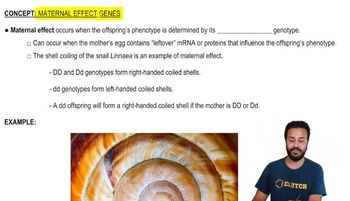
In early embryonic development, maternal gene products (mRNAs and proteins) deposited in the egg are utilized before the zygotic genome is activated. Maternal gene activity supports initial development, while zygotic gene activity becomes critical as the embryo transitions to later stages. The ability of embryos to develop past the blastula stage in the presence of actinomycin D indicates reliance on maternal gene products.
Video consigliato:
Percorso guidato
03:38
Maternal Effect

Gastrulation

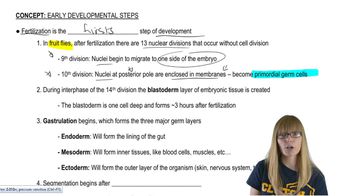
Gastrulation is a pivotal phase in embryonic development where the single-layered blastula reorganizes into a multi-layered structure, establishing the three primary germ layers: ectoderm, mesoderm, and endoderm. This process is essential for the proper formation of tissues and organs. The cessation of development before gastrulation in the presence of actinomycin D suggests that zygotic gene expression is necessary for this critical transition.
Video consigliato:
Percorso guidato
03:46
Drosophilia Development