Ch. 2 - Transmission Genetics
Sanders - Genetic Analysis: An Integrated Approach 3rd Edition
Sanders3rd EditionGenetic Analysis: An Integrated ApproachISBN: 9780135564172Non è quello che usi tu?Cambia libro di testo
Capitolo 2, Problema 16b

A geneticist crosses a pure-breeding strain of peas producing yellow, wrinkled seeds with one that is pure-breeding for green, round seeds.
What proportion of the F₂ progeny are expected to have yellow seeds? Wrinkled seeds? Green seeds? Round seeds?

Guida verificata passo dopo passo
1
Step 1: Identify the traits and their inheritance patterns. Yellow and green seed color are determined by one gene, and round and wrinkled seed shape are determined by another gene. Assume Mendelian inheritance where one allele is dominant and the other is recessive for each trait.
Step 2: Assign alleles to the traits. Let 'Y' represent the dominant allele for yellow seeds and 'y' represent the recessive allele for green seeds. Similarly, let 'R' represent the dominant allele for round seeds and 'r' represent the recessive allele for wrinkled seeds.
Step 3: Determine the genotypes of the parental strains. The pure-breeding yellow, wrinkled strain will have the genotype YYrr, and the pure-breeding green, round strain will have the genotype yyRR.
Step 4: Perform a dihybrid cross to determine the F₁ generation. Cross YYrr with yyRR. The F₁ progeny will all be heterozygous for both traits (YyRr), producing yellow, round seeds due to the dominance of 'Y' and 'R'.
Step 5: Use a Punnett square to analyze the F₂ generation. Cross two F₁ individuals (YyRr × YyRr) to determine the proportions of each phenotype. Calculate the expected proportions for yellow seeds, wrinkled seeds, green seeds, and round seeds based on the combinations of alleles in the Punnett square.

Risposta video verificata per un problema simile:

Questa soluzione video è stata consigliata dai nostri tutor come utile per risolvere questo problema.
Durata del video:
2m

Concetti chiave

Ecco i concetti essenziali che devi comprendere per rispondere correttamente alla domanda.

Mendelian Genetics

Mendelian genetics is the study of how traits are inherited through generations, based on the principles established by Gregor Mendel. It involves understanding dominant and recessive alleles, where dominant traits mask the expression of recessive ones. In this case, yellow seeds (dominant) and green seeds (recessive) are key traits in the pea plants being studied.
Video consigliato:
Percorso guidato
03:45
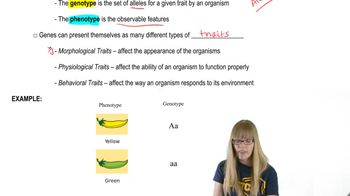
Descriptive Genetics

Punnett Square

A Punnett square is a diagram used to predict the genotypic and phenotypic ratios of offspring from a genetic cross. By organizing the alleles of the parent plants, it allows for a visual representation of how traits may combine in the F1 and F2 generations. This tool is essential for determining the expected proportions of yellow, green, wrinkled, and round seeds in the progeny.
Video consigliato:
Percorso guidato
18:27
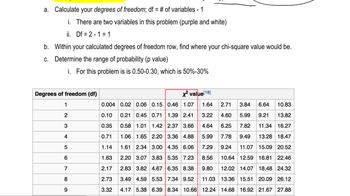
Chi Square Analysis

Phenotypic Ratios

Phenotypic ratios refer to the relative frequencies of different phenotypes in the offspring resulting from a genetic cross. In this scenario, the F2 generation will exhibit a specific ratio of yellow to green seeds and wrinkled to round seeds based on the inheritance patterns. Understanding these ratios helps predict the expected traits in the progeny from the initial cross.
Video consigliato:
Percorso guidato
10:48
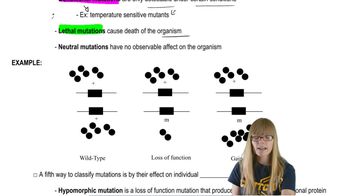
Mutations and Phenotypes
Pratica correlata
Domanda del libro di testo

Suppose an F₁ dihybrid (round yellow plant from Problem 16) is crossed to the pure-breeding green, round parental strain. Use a forked-line diagram to predict the phenotypic distribution of the resulting progeny.

466
views
Domanda del libro di testo

A geneticist crosses a pure-breeding strain of peas producing yellow, wrinkled seeds with one that is pure-breeding for green, round seeds.

What is the expected phenotype distribution among the F₂ progeny?

414
views
Domanda del libro di testo

The accompanying pedigree shows the transmission of albinism (absence of skin pigment) in a human family.

What is the probability that female I-3 is a heterozygous carrier of the allele for albinism? 

870
views
Domanda del libro di testo

The accompanying pedigree shows the transmission of albinism (absence of skin pigment) in a human family.

One child of female I-3 has albinism. What is the probability that any of the other four children are carriers of the allele for albinism? 

894
views
Domanda del libro di testo

In pea plants, the appearance of flowers along the main stem is a dominant phenotype called 'axial' and is controlled by an allele T. The recessive phenotype, produced by an allele t, has flowers only at the end of the stem and is called 'terminal.' Pod form displays a dominant phenotype, 'inflated,' controlled by an allele C, and a recessive 'constricted' form, produced by the c allele. A cross is made between a pure-breeding axial, constricted plant and a plant that is pure-breeding terminal, inflated.

The F₁ progeny of this cross are allowed to self-fertilize. What is the expected phenotypic distribution among the F₂ progeny?

476
views
Domanda del libro di testo

A geneticist crosses a pure-breeding strain of peas producing yellow, wrinkled seeds with one that is pure-breeding for green, round seeds.

Use a Punnett square to predict the F₂ progeny that would be expected if the F₁ are allowed to self-fertilize.

563
views