Ch. 2 - Transmission Genetics
Sanders - Genetic Analysis: An Integrated Approach 3rd Edition
Sanders3rd EditionGenetic Analysis: An Integrated ApproachISBN: 9780135564172Non è quello che usi tu?Cambia libro di testo
Capitolo 2, Problema 6a

Consider the cross AaBbCC × AABbCc.
How many different gamete genotypes can each organism produce?

Guida verificata passo dopo passo
1
Step 1: Understand the problem. The question asks how many different gamete genotypes can be produced by each organism in the given cross. Gametes are formed through meiosis, where alleles segregate independently according to Mendel's laws.
Step 2: Analyze the genotype of the first organism (AaBbCC). For each gene, determine the number of allele combinations that can be passed to the gametes. Gene A has two alleles (A and a), Gene B has two alleles (B and b), and Gene C has only one allele (C, since it is homozygous). The total number of gamete genotypes is calculated by multiplying the number of allele combinations for each gene: 2 × 2 × 1.
Step 3: Analyze the genotype of the second organism (AABbCc). Gene A has only one allele (A, since it is homozygous), Gene B has two alleles (B and b), and Gene C has two alleles (C and c). The total number of gamete genotypes is calculated by multiplying the number of allele combinations for each gene: 1 × 2 × 2.
Step 4: Use the formula for calculating the number of gamete genotypes: \( \text{Number of gamete genotypes} = \text{Number of allele combinations for Gene A} \times \text{Number of allele combinations for Gene B} \times \text{Number of allele combinations for Gene C} \). Apply this formula to each organism's genotype.
Step 5: Summarize the results. The first organism (AaBbCC) produces gametes based on the combinations of alleles from its genotype, and the second organism (AABbCc) produces gametes based on its genotype. Multiply the allele combinations for each gene to determine the number of gamete genotypes for each organism.

Risposta video verificata per un problema simile:

Questa soluzione video è stata consigliata dai nostri tutor come utile per risolvere questo problema.
Durata del video:
2m

Concetti chiave

Ecco i concetti essenziali che devi comprendere per rispondere correttamente alla domanda.

Gamete Formation

Gamete formation is the process by which organisms produce reproductive cells (gametes) through meiosis. Each gamete carries half the genetic information of the parent organism, resulting in a unique combination of alleles. Understanding how alleles segregate during gamete formation is crucial for predicting the genetic outcomes of crosses.
Video consigliato:
Percorso guidato
04:06
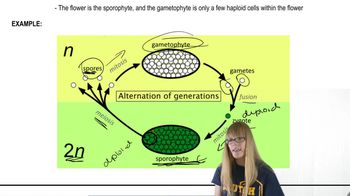
Formation of Plant Gametes

Independent Assortment

Independent assortment is a principle of genetics stating that alleles for different traits segregate independently of one another during gamete formation. This means that the inheritance of one trait does not affect the inheritance of another, allowing for a variety of combinations in the gametes produced by an organism.
Video consigliato:
Percorso guidato
04:58
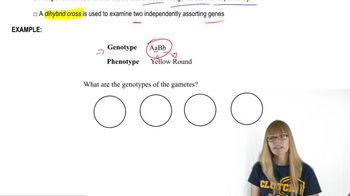
Gamete Genetics and Independent Assortment

Punnett Square

A Punnett square is a diagram used to predict the genotypes of offspring from a genetic cross. By organizing the possible gametes from each parent, it allows for a visual representation of how alleles combine, making it easier to calculate the number of different genotypes that can arise from a given cross.
Video consigliato:
Percorso guidato
18:27
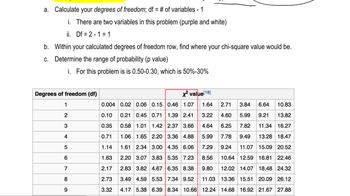
Chi Square Analysis