Ch. 2 - Transmission Genetics
Sanders - Genetic Analysis: An Integrated Approach 3rd Edition
Sanders3rd EditionGenetic Analysis: An Integrated ApproachISBN: 9780135564172Non è quello che usi tu?Cambia libro di testo
Capitolo 2, Problema 8h

Determine whether the statements below are true or false. If a statement is false, provide the correct information or revise the statement to make it correct.
If a dihybrid plant is self-fertilized,
(1) 9/16 of the progeny will have the same phenotype as the F₁ parent.
(2) 1/16 of the progeny will be true-breeding.
(3) 1/2 of the progeny will be heterozygous at one or both loci.

Guida verificata passo dopo passo
1
Step 1: Understand the context of the problem. A dihybrid plant refers to an organism heterozygous at two loci (e.g., AaBb). When such a plant is self-fertilized, the offspring will follow Mendel's dihybrid cross ratio of 9:3:3:1 for phenotypes, assuming independent assortment and no linkage between the loci.
Step 2: Analyze statement (1): '9/16 of the progeny will have the same phenotype as the F₁ parent.' The F₁ parent in a dihybrid cross typically exhibits the dominant phenotype for both traits. Using the 9:3:3:1 ratio, 9/16 of the progeny will indeed show the dominant phenotype for both traits. This statement is true.
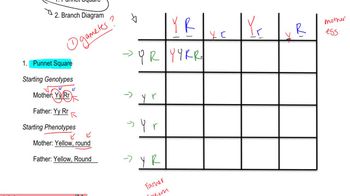
Step 3: Analyze statement (2): '1/16 of the progeny will be true-breeding.' True-breeding individuals are homozygous at both loci (e.g., AABB or aabb). From the Punnett square of a dihybrid cross, there are four true-breeding genotypes: AABB, AAbb, aaBB, and aabb. Each occurs with a probability of 1/16. Therefore, the total proportion of true-breeding progeny is 4/16, not 1/16. This statement is false. The correct information is that 4/16 (or 1/4) of the progeny will be true-breeding.
Step 4: Analyze statement (3): '1/2 of the progeny will be heterozygous at one or both loci.' To verify this, calculate the probabilities of heterozygosity at one or both loci. Heterozygous at one locus includes genotypes AaBB, Aabb, aaBb, and AABb, each occurring with a probability of 2/16. Heterozygous at both loci (AaBb) occurs with a probability of 4/16. Adding these probabilities gives (2/16 + 2/16 + 2/16 + 2/16 + 4/16) = 12/16 = 3/4. This statement is false. The correct proportion is 3/4, not 1/2.
Step 5: Summarize the findings: Statement (1) is true. Statement (2) is false; the correct proportion of true-breeding progeny is 4/16 (or 1/4). Statement (3) is false; the correct proportion of progeny heterozygous at one or both loci is 3/4.

Risposta video verificata per un problema simile:

Questa soluzione video è stata consigliata dai nostri tutor come utile per risolvere questo problema.
Durata del video:
5m

Concetti chiave

Ecco i concetti essenziali che devi comprendere per rispondere correttamente alla domanda.

Dihybrid Cross

A dihybrid cross involves two traits, each represented by two alleles. In Mendelian genetics, when two heterozygous individuals (e.g., AaBb x AaBb) are crossed, the phenotypic ratio of the offspring typically follows a 9:3:3:1 pattern. This means that 9 out of 16 offspring will display the dominant phenotype for both traits, which is crucial for understanding the expected outcomes in the given question.
Video consigliato:

True-Breeding

True-breeding organisms are homozygous for a particular trait, meaning they consistently produce offspring with the same phenotype when self-fertilized. In the context of a dihybrid cross, true-breeding progeny can be identified as those that exhibit the same traits as their parents, which is essential for determining the proportion of true-breeding offspring in the progeny.
Video consigliato:
Percorso guidato
18:27
Chi Square Analysis

Heterozygosity

Heterozygosity refers to the presence of different alleles at a gene locus in an individual. In a dihybrid cross, the proportion of heterozygous offspring can be calculated based on the genotypic ratios. Understanding the distribution of heterozygous individuals is important for evaluating the genetic diversity and potential for variation in the progeny resulting from the self-fertilization of a dihybrid plant.
Video consigliato:
Pratica correlata
Domanda del libro di testo

The dorsal pigment pattern of frogs can be either 'leopard' (white pigment between dark spots) or 'mottled' (pigment between spots appears mottled). The trait is controlled by an autosomal gene. Males and females are selected from pure-breeding populations, and a pair of reciprocal crosses is performed. The cross results are shown below.

    Cross 1:  P₁: Male leopard x male mottled

             F₁: All mottled

             F₂: 70 mottled, 22 leopard

    Cross 2:  P₁: Male mottled x female leopard

             F₁: All mottled

             F₂: 50 mottled, 18 leopard

Which of the phenotypes is dominant? Explain your answer.

498
views
Domanda del libro di testo

Determine whether the statements below are true or false. If a statement is false, provide the correct information or revise the statement to make it correct.

Reciprocal crosses that produce identical results demonstrate that a strain is pure-breeding.

498
views
Domanda del libro di testo

Determine whether the statements below are true or false. If a statement is false, provide the correct information or revise the statement to make it correct.


The progeny of a trihybrid cross are expected to have one of 27 different genotypes.

457
views
Domanda del libro di testo

Determine whether the statements below are true or false. If a statement is false, provide the correct information or revise the statement to make it correct.

If a woman is heterozygous for albinism, an autosomal recessive condition that results in the absence of skin pigment, the proportion of her gametes carrying the allele that allows pigment expression is expected to be 75%.

477
views
Domanda del libro di testo

In the datura plant, purple flower color is controlled by a dominant allele, P. White flowers are found in plants homozygous for the recessive allele p. Suppose that a purple-flowered datura plant with an unknown genotype is self-fertilized and that its progeny are 28 purple-flowered plants and 10 white-flowered plants.

Use the results of the self-fertilization to determine the genotype of the original purple-flowered plant.

428
views
Domanda del libro di testo

In the datura plant, purple flower color is controlled by a dominant allele, P. White flowers are found in plants homozygous for the recessive allele p. Suppose that a purple-flowered datura plant with an unknown genotype is self-fertilized and that its progeny are 28 purple-flowered plants and 10 white-flowered plants.

If one of the purple-flowered progeny plants is selected at random and self-fertilized, what is the probability it will breed true?

696
views