
Domanda del libro di testo
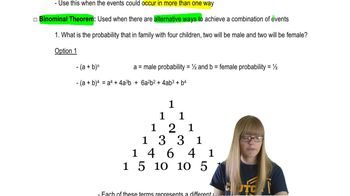
If two six-sided dice are rolled, what is the probability that the total number of spots showing is
an odd number?
660
views

 Guida verificata passo dopo passo
 07:41
07:41
 11:06
11:06 08:04
08:04If two six-sided dice are rolled, what is the probability that the total number of spots showing is
an odd number?
In pea plants, the appearance of flowers along the main stem is a dominant phenotype called 'axial' and is controlled by an allele T. The recessive phenotype, produced by an allele t, has flowers only at the end of the stem and is called 'terminal.' Pod form displays a dominant phenotype, 'inflated,' controlled by an allele C, and a recessive 'constricted' form, produced by the c allele. A cross is made between a pure-breeding axial, constricted plant and a plant that is pure-breeding terminal, inflated.
If the plants with terminal flowers produced by the cross in part (c) are saved and allowed to self-fertilize, what is the expected phenotypic distribution among the progeny?
In pea plants, the appearance of flowers along the main stem is a dominant phenotype called 'axial' and is controlled by an allele T. The recessive phenotype, produced by an allele t, has flowers only at the end of the stem and is called 'terminal.' Pod form displays a dominant phenotype, 'inflated,' controlled by an allele C, and a recessive 'constricted' form, produced by the c allele. A cross is made between a pure-breeding axial, constricted plant and a plant that is pure-breeding terminal, inflated.
If an F₁ plant from the initial cross described above is crossed with a plant that is terminal, constricted, what is the expected distribution among the resulting progeny?
If two six-sided dice are rolled, what is the probability that the total number of spots showing is
greater than 5?
In pea plants, the appearance of flowers along the main stem is a dominant phenotype called 'axial' and is controlled by an allele T. The recessive phenotype, produced by an allele t, has flowers only at the end of the stem and is called 'terminal.' Pod form displays a dominant phenotype, 'inflated,' controlled by an allele C, and a recessive 'constricted' form, produced by the c allele. A cross is made between a pure-breeding axial, constricted plant and a plant that is pure-breeding terminal, inflated.
Suppose that all of the F₂ progeny with terminal flowers, i.e., plants with terminal flowers and inflated pods and plants with terminal flowers and constricted pods, are saved and allowed to self-fertilize to produce a partial F₃ generation. What is the expected phenotypic distribution among these F₃ plants?
If two six-sided dice are rolled, what is the probability that the total number of spots showing is 7?