Ch. 20 - Population Genetics and Evolution at the Population, Species, and Molecular Levels
Sanders - Genetic Analysis: An Integrated Approach 3rd Edition
Sanders3rd EditionGenetic Analysis: An Integrated ApproachISBN: 9780135564172Non è quello che usi tu?Cambia libro di testo
Capitolo 20, Problema 32a

The frequency of an autosomal recessive condition is 0.001 (1 in 1000) in a population.
What is the frequency of the mutant allele?

Guida verificata passo dopo passo
1
Understand that the problem involves Hardy-Weinberg equilibrium, which is used to calculate allele frequencies in a population. The frequency of the autosomal recessive condition (q²) is given as 0.001.
Recall the Hardy-Weinberg equation: p² + 2pq + q² = 1, where p is the frequency of the dominant allele, q is the frequency of the recessive allele, p² represents the frequency of homozygous dominant individuals, 2pq represents the frequency of heterozygous individuals, and q² represents the frequency of homozygous recessive individuals.
To find the frequency of the mutant allele (q), take the square root of q². Use the formula: q².
Substitute the given value of q² (0.001) into the formula: 0.001. This will give the value of q, which represents the frequency of the mutant allele.
Conclude that the calculated value of q represents the frequency of the mutant allele in the population. Ensure that the result is expressed as a decimal or percentage, depending on the context of the problem.

Risposta video verificata per un problema simile:

Questa soluzione video è stata consigliata dai nostri tutor come utile per risolvere questo problema.
Durata del video:
1m

Concetti chiave

Ecco i concetti essenziali che devi comprendere per rispondere correttamente alla domanda.

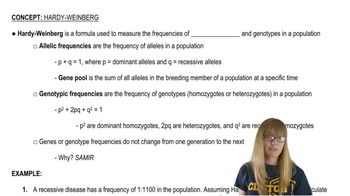
Hardy-Weinberg Principle

The Hardy-Weinberg Principle provides a mathematical framework for understanding allele and genotype frequencies in a population at equilibrium. It states that in a large, randomly mating population with no evolutionary influences, the frequencies of alleles and genotypes will remain constant from generation to generation. This principle is essential for calculating allele frequencies, particularly in the context of autosomal recessive conditions.
Video consigliato:

Allele Frequency

Allele frequency refers to how often a particular allele appears in a population compared to other alleles for the same gene. In the case of an autosomal recessive condition, the frequency of the mutant allele can be derived from the frequency of affected individuals. Understanding allele frequency is crucial for predicting the likelihood of genetic conditions within a population.
Video consigliato:
Percorso guidato
03:03
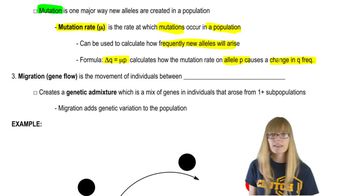
New Alleles and Migration

Autosomal Recessive Inheritance

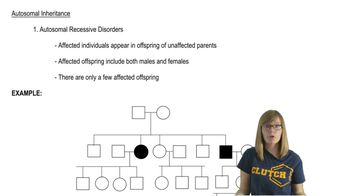
Autosomal recessive inheritance occurs when two copies of a mutant allele are necessary for an individual to express a trait or condition. In a population, the frequency of affected individuals can be used to estimate the frequency of the recessive allele using the formula q^2 = frequency of affected individuals, where q represents the frequency of the recessive allele. This concept is fundamental for solving questions related to genetic conditions and their prevalence.
Video consigliato:
Percorso guidato
09:08
Autosomal Pedigrees
Pratica correlata
Domanda del libro di testo

Evaluate the following pedigree, and answer the questions below for individual IV-1. Is IV-1 an inbred individual? If so, who is/are the common ancestor(s)?

485
views
Domanda del libro di testo

Albinism, an autosomal recessive trait characterized by an absence of skin pigmentation, is found in 1 in 4000 people in populations at equilibrium. Brachydactyly, an autosomal dominant trait producing shortened fingers and toes, is found in 1 in 6000 people in populations at equilibrium. For each of these traits, calculate the frequency of heterozygotes in the population

821
views
Domanda del libro di testo

The frequency of an autosomal recessive condition is 0.001 (1 in 1000) in a population.

Assuming individuals mate at random, what is the chance that two heterozygous individuals will mate?

892
views
Domanda del libro di testo

The frequency of an autosomal recessive condition is 0.001 (1 in 1000) in a population.

What is the frequency of carriers of the mutant allele?

1825
views
Domanda del libro di testo

Albinism, an autosomal recessive trait characterized by an absence of skin pigmentation, is found in 1 in 4000 people in populations at equilibrium. Brachydactyly, an autosomal dominant trait producing shortened fingers and toes, is found in 1 in 6000 people in populations at equilibrium. For each of these traits, calculate the frequency of For albinism only, what is the frequency of mating between heterozygotes?

1056
views
Domanda del libro di testo

Albinism, an autosomal recessive trait characterized by an absence of skin pigmentation, is found in 1 in 4000 people in populations at equilibrium. Brachydactyly, an autosomal dominant trait producing shortened fingers and toes, is found in 1 in 6000 people in populations at equilibrium. For each of these traits, calculate the frequency of the dominant allele at the locus

854
views