Ch. 3 - Cell Division and Chromosome Heredity
Sanders - Genetic Analysis: An Integrated Approach 3rd Edition
Sanders3rd EditionGenetic Analysis: An Integrated ApproachISBN: 9780135564172Non è quello che usi tu?Cambia libro di testo
Capitolo 3, Problema 7

Explain how the behavior of homologous chromosomes in meiosis parallels Mendel's law of segregation for autosomal alleles D and d. During which stage of M phase do these two alleles segregate from one another?

Guida verificata passo dopo passo
1
Understand Mendel's law of segregation: This law states that during the formation of gametes, the two alleles for a given gene separate so that each gamete receives only one allele. This is a fundamental principle of inheritance.
Recognize the role of homologous chromosomes in meiosis: Homologous chromosomes are pairs of chromosomes (one from each parent) that carry the same genes but may have different alleles (e.g., D and d). These chromosomes segregate during meiosis, ensuring that each gamete receives one chromosome from each pair.
Identify the stage of meiosis where segregation occurs: During meiosis I, specifically in anaphase I, homologous chromosomes (and their respective alleles, such as D and d) are pulled to opposite poles of the cell. This is the physical basis for Mendel's law of segregation.
Explain the parallel: The separation of homologous chromosomes during anaphase I mirrors Mendel's observation that alleles segregate into different gametes. Each gamete ends up with one allele (either D or d) because the homologous chromosomes carrying these alleles are separated.
Conclude with the importance of meiosis: This process ensures genetic diversity and the proper distribution of alleles to gametes, which is essential for inheritance patterns observed by Mendel.

Risposta video verificata per un problema simile:

Questa soluzione video è stata consigliata dai nostri tutor come utile per risolvere questo problema.
Durata del video:
3m

Concetti chiave

Ecco i concetti essenziali che devi comprendere per rispondere correttamente alla domanda.

Homologous Chromosomes

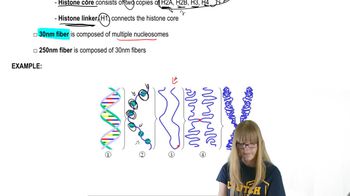
Homologous chromosomes are pairs of chromosomes in a diploid organism, one inherited from each parent. They carry the same genes at the same loci but may have different alleles. During meiosis, these chromosomes undergo pairing and recombination, which is crucial for genetic diversity. Understanding their behavior is essential for grasping how alleles segregate during gamete formation.
Video consigliato:
Percorso guidato
07:10
Chromosome Structure

Mendel's Law of Segregation

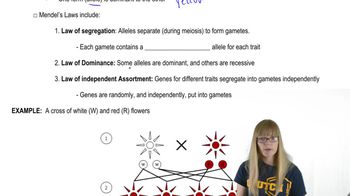
Mendel's Law of Segregation states that during the formation of gametes, the two alleles for a trait separate from each other so that each gamete carries only one allele for each gene. This principle explains how offspring inherit one allele from each parent. The law is illustrated during meiosis when homologous chromosomes are separated, ensuring that each gamete receives only one allele from each gene pair.
Video consigliato:

Meiosis Stages

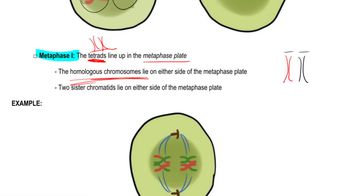
Meiosis consists of two rounds of cell division: meiosis I and meiosis II. The segregation of alleles occurs during anaphase I of meiosis I, when homologous chromosomes are pulled apart to opposite poles of the cell. This separation ensures that each gamete receives one allele from each pair of homologous chromosomes, aligning with Mendel's law of segregation and contributing to genetic variation in offspring.
Video consigliato:
Pratica correlata
Domanda del libro di testo

How many Barr bodies are found in a normal human female nucleus? In a normal male nucleus?

504
views
Domanda del libro di testo

The diploid number of the hypothetical animal Geneticus introductus is 2n = 36. Each diploid nucleus contains 3 ng of DNA in G₁.

Explain why a somatic cell of Geneticus introductus has the same number of chromosomes and the same amount of DNA at the beginning of mitotic prophase as one of these cells does at the beginning of prophase I of meiosis.

576
views
Domanda del libro di testo

Alleles A and a are on one pair of autosomes, and alleles B and b are on a separate pair of autosomes. Does crossover between one pair of homologs affect the expected proportions of gamete genotypes? Why or why not? Does crossover between both pairs of chromosomes affect the expected gamete proportions? Why or why not?

568
views
Domanda del libro di testo

An organism has alleles R₁ and R₂ on one pair of homologous chromosomes, and it has alleles T₁ and T₂ on another pair. Diagram these pairs of homologs at the end of metaphase I, the end of telophase I, and the end of telophase II, and show how meiosis in this organism produces gametes in expected Mendelian proportions. Assume no crossover between homologous chromosomes.

484
views
Domanda del libro di testo

Suppose crossover occurs between the homologous chromosomes in the previous problem. At what stage of M phase do alleles D and d segregate?

601
views
Domanda del libro di testo

The diploid number of the hypothetical animal Geneticus introductus is 2n = 36. Each diploid nucleus contains 3 ng of DNA in G₁.

Complete the following table by entering the number of chromosomes and amount of DNA present per cell at the end of each stage listed.

377
views