Ch. 3 - Cell Division and Chromosome Heredity
Sanders - Genetic Analysis: An Integrated Approach 3rd Edition
Sanders3rd EditionGenetic Analysis: An Integrated ApproachISBN: 9780135564172Non è quello che usi tu?Cambia libro di testo
Capitolo 3, Problema 22

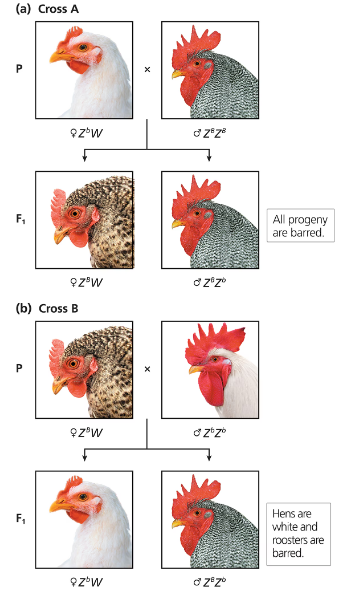
The following figure illustrates reciprocal crosses involving chickens with sex-linked dominant barred mutation. For Cross A and for Cross B, cross the F₁ roosters and hens and predict the feather patterns of roosters and hens in the F2.
Diagram showing reciprocal crosses of chickens with sex-linked barred mutation, predicting barred and white feather patterns in offspring.

Guida verificata passo dopo passo
1
Step 1: Understand the genetic basis of the trait. Since the barred mutation is sex-linked and dominant, it is located on the Z chromosome (chickens have ZW sex determination, where males are ZZ and females are ZW). The barred allele (B) is dominant over the non-barred allele (b).
Step 2: Identify the genotypes of the F₁ roosters and hens from Cross A and Cross B. Use the information from the reciprocal crosses to determine which parent contributed which allele, keeping in mind that males have two Z chromosomes (ZZ) and females have one Z and one W chromosome (ZW).
Step 3: Set up Punnett squares for the F₁ crosses. Since males are ZZ and females are ZW, the male contributes one Z chromosome to all offspring, while the female contributes either a Z or a W chromosome. Use the genotypes of the F₁ parents to determine the possible allele combinations in the F₂ generation.
Step 4: Predict the phenotypes of the F₂ offspring by considering the dominance of the barred allele. For males (ZZ), having at least one B allele will result in barred feathers; for females (ZW), having the B allele on the single Z chromosome will result in barred feathers, while the W chromosome does not carry this gene.
Step 5: Summarize the expected feather patterns in the F₂ generation for both roosters and hens, indicating the proportion of barred and non-barred individuals based on the genotypic ratios derived from the Punnett squares.

Risposta video verificata per un problema simile:

Questa soluzione video è stata consigliata dai nostri tutor come utile per risolvere questo problema.
Durata del video:
54s

Concetti chiave

Ecco i concetti essenziali che devi comprendere per rispondere correttamente alla domanda.

Sex-Linked Inheritance

Sex-linked inheritance refers to genes located on sex chromosomes, typically the X chromosome in chickens. Traits linked to these chromosomes show different inheritance patterns in males and females because males have one X and one Y chromosome, while females have two X chromosomes.
Video consigliato:
Percorso guidato
07:56
Sex-Linked Genes

Dominant and Recessive Alleles

Dominant alleles express their trait even if only one copy is present, while recessive alleles require two copies to be expressed. In sex-linked dominant mutations, a single copy of the mutant allele on the X chromosome causes the trait to appear in both males and females.
Video consigliato:
Percorso guidato
04:37
Variations on Dominance

Reciprocal Crosses and Predicting F2 Phenotypes

Reciprocal crosses involve switching the sexes of the parents with specific traits to study inheritance patterns. Predicting F2 phenotypes requires understanding how alleles segregate and combine in offspring, considering sex linkage and dominance to determine the expected feather patterns in male and female progeny.
Video consigliato:
Percorso guidato
11:42
Morgan's Studies of Crossing Over
Pratica correlata
Domanda del libro di testo

In a species of fish, a black spot on the dorsal fin is observed in males and females. A fish breeder carries out a pair of reciprocal crosses and observes the following results.


Why does this evidence support the hypothesis that a black spot is sex linked?

471
views
Domanda del libro di testo

In fruit flies, yellow body (y) is recessive to gray body , and the trait of body color is inherited on the X chromosome. Vestigial wing (v) is recessive to full-sized wing (v⁺), and the trait has autosomal inheritance. A cross of a male with yellow body and full wings to a female with gray body and full wings is made. Based on an analysis of the progeny of the cross shown below, determine the genotypes of parental and progeny flies.

[Table below appears at this point containing crosses and results]

1820
views
Domanda del libro di testo

Use the blank pedigrees provided to depict transmission of

(a) an X-linked recessive trait and

(b) an X-linked dominant trait, by filling in circles and squares to represent individuals with the trait of interest. Give genotypes for each person in each pedigree.

Carefully design each transmission pattern so that pedigree

(a) cannot be confused with autosomal recessive transmission and pedigree

(b) cannot be confused with autosomal dominant transmission. Identify the transmission events that eliminate the possibility of autosomal transmission for each pedigree.

647
views
Domanda del libro di testo

For each pedigree shown,

Identify which pattern(s) of transmission is/are impossible. Specify why transmission is impossible.

547
views
Domanda del libro di testo

For each pedigree shown,

Determine which other pattern(s) of transmission is/are possible. For each possible mode of transmission, specify the genotypes necessary for transmission to occur.

519
views
Domanda del libro di testo

In a species of fish, a black spot on the dorsal fin is observed in males and females. A fish breeder carries out a pair of reciprocal crosses and observes the following results.

Identify which sex is heterogametic. Give genotypes for the parents in each cross, and explain the progeny proportions in each cross.

470
views