Ch. 3 - Cell Division and Chromosome Heredity
Sanders - Genetic Analysis: An Integrated Approach 3rd Edition
Sanders3rd EditionGenetic Analysis: An Integrated ApproachISBN: 9780135564172Non è quello che usi tu?Cambia libro di testo
Capitolo 3, Problema 2a

Our closest primate relative, the chimpanzee, has a diploid number of 2n = 48. For each of the following stages of M phase, identify the number of chromosomes present in each cell.
End of mitotic telophase

Guida verificata passo dopo passo
1
Understand that the diploid number (2n) represents the total number of chromosomes in a somatic cell of the organism. For chimpanzees, this is 48 chromosomes.
Recall that during mitosis, the goal is to produce two genetically identical daughter cells, each with the same diploid number of chromosomes as the parent cell.
At the end of mitotic telophase, the chromosomes have been separated into two groups, one for each forming daughter cell. However, the cell has not yet fully divided (cytokinesis has not occurred).
Each group of chromosomes in the forming daughter cells will have the same diploid number as the parent cell, which is 48 chromosomes.
Conclude that at the end of mitotic telophase, each forming daughter cell contains 48 chromosomes, and the total number of chromosomes in the entire cell (before cytokinesis) is 96 (48 in each group).

Risposta video verificata per un problema simile:

Questa soluzione video è stata consigliata dai nostri tutor come utile per risolvere questo problema.
Durata del video:
2m

Concetti chiave

Ecco i concetti essenziali che devi comprendere per rispondere correttamente alla domanda.

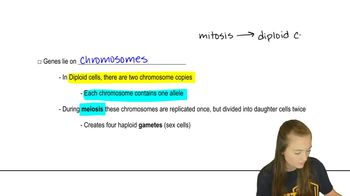
Diploid Number

The diploid number (2n) refers to the total number of chromosomes in a somatic cell, where chromosomes exist in pairs. In the case of chimpanzees, the diploid number is 48, meaning there are 24 pairs of homologous chromosomes. This concept is crucial for understanding how chromosomes are distributed during cell division.
Video consigliato:
Percorso guidato
27:36
Diploid Genetics

M Phase of Cell Cycle

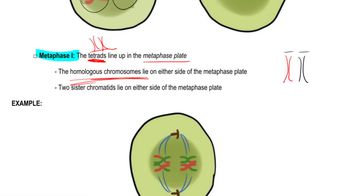
The M phase, or mitotic phase, is the part of the cell cycle where cell division occurs, including mitosis and cytokinesis. During this phase, the cell undergoes several stages: prophase, metaphase, anaphase, and telophase, leading to the separation of sister chromatids and the formation of two daughter cells. Understanding the M phase is essential for determining the number of chromosomes at various stages of cell division.
Video consigliato:
Percorso guidato
04:29
Bacteriophage Life Cycle

Mitotic Telophase

Mitotic telophase is the final stage of mitosis, where the separated sister chromatids reach opposite poles of the cell and begin to decondense back into chromatin. At the end of telophase, the cell has two nuclei, each containing the same diploid number of chromosomes as the original cell. Therefore, at the end of mitotic telophase in chimpanzees, there would be 48 chromosomes in each daughter nucleus.
Video consigliato: