Ch. 3 - Cell Division and Chromosome Heredity
Sanders - Genetic Analysis: An Integrated Approach 3rd Edition
Sanders3rd EditionGenetic Analysis: An Integrated ApproachISBN: 9780135564172Non è quello che usi tu?Cambia libro di testo
Capitolo 3, Problema 2f

Our closest primate relative, the chimpanzee, has a diploid number of 2n = 48. For each of the following stages of M phase, identify the number of chromosomes present in each cell.
Early prophase I

Guida verificata passo dopo passo
1
Understand the diploid number (2n) of the organism: The diploid number for chimpanzees is given as 2n = 48. This means that in a diploid cell, there are 48 chromosomes, or 24 homologous pairs of chromosomes.
Recall the stage of meiosis being discussed: Early prophase I is the first stage of meiosis I, where homologous chromosomes begin to condense and pair up. At this stage, the cell is still diploid, and no division has occurred yet.
Determine the number of chromosomes in early prophase I: Since the cell is diploid at this stage, the number of chromosomes remains the same as the diploid number, which is 48 chromosomes.
Clarify the state of the chromosomes: Each chromosome at this stage has already undergone DNA replication during the S phase of the cell cycle. Therefore, each chromosome consists of two sister chromatids, but the chromosome count is still based on centromeres, not chromatids.
Conclude the chromosome count: In early prophase I, the number of chromosomes in the cell is 48, as no division or separation of homologous chromosomes has occurred yet.

Risposta video verificata per un problema simile:

Questa soluzione video è stata consigliata dai nostri tutor come utile per risolvere questo problema.
Durata del video:
1m

Concetti chiave

Ecco i concetti essenziali che devi comprendere per rispondere correttamente alla domanda.

Diploid Number

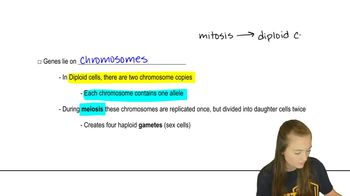
The diploid number (2n) refers to the total number of chromosomes in a somatic cell, where chromosomes exist in pairs. In the case of chimpanzees, the diploid number is 48, meaning there are 24 pairs of homologous chromosomes. This concept is crucial for understanding how chromosomes are organized and distributed during cell division.
Video consigliato:
Percorso guidato
27:36
Diploid Genetics

M Phase of Cell Cycle

M Phase, or mitotic phase, is the stage of the cell cycle where cell division occurs, including both mitosis and cytokinesis. During this phase, the cell's chromosomes condense and become visible under a microscope. Understanding M Phase is essential for determining the number of chromosomes present at various stages of cell division, such as prophase.
Video consigliato:
Percorso guidato
04:29
Bacteriophage Life Cycle

Prophase I of Meiosis

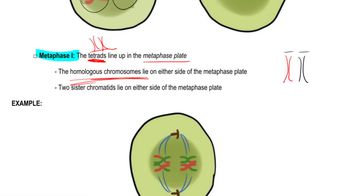
Prophase I is the first stage of meiosis, where homologous chromosomes pair up and exchange genetic material through a process called crossing over. In this stage, the diploid number of chromosomes is still present, but they are organized into tetrads (pairs of homologous chromosomes). For chimpanzees, this means that during early prophase I, there are still 48 chromosomes, but they are in a paired configuration.
Video consigliato:
Pratica correlata
Domanda del libro di testo

Our closest primate relative, the chimpanzee, has a diploid number of 2n = 48. For each of the following stages of M phase, identify the number of chromosomes present in each cell.

End of meiotic anaphase II

697
views
Domanda del libro di testo

For the retinal cancer retinoblastoma, the inheritance of one mutated copy of RB1 from one of the parents is often referred to as a mutation that produces a 'dominant predisposition to cancer.' This means that the first mutation does not produce cancer but makes it very likely that cancer will develop.


What is the genotype of a normal cell in the retina in a person who has sporadic retinoblastoma? What is the normal cell genotype if the person has hereditary retinoblastoma? Explain the reason for the difference between the genotypes.

403
views
Domanda del libro di testo

Our closest primate relative, the chimpanzee, has a diploid number of 2n = 48. For each of the following stages of M phase, identify the number of chromosomes present in each cell.

Early mitotic prophase

541
views
Domanda del libro di testo

For the retinal cancer retinoblastoma, the inheritance of one mutated copy of RB1 from one of the parents is often referred to as a mutation that produces a 'dominant predisposition to cancer.' This means that the first mutation does not produce cancer but makes it very likely that cancer will develop.

Using RB1⁺ for the normal wild-type allele and RB1⁻ for the mutant allele, identify the genotype of a cell in a retinoblastoma tumor.

459
views
Domanda del libro di testo

In a test of his chromosome theory of heredity, Morgan crossed a female Drosophila with red eyes to a male with white eyes. The females were produced from Cross A, shown in the Figure below. Predict the offspring Morgan would have expected under his hypothesis that the gene for eye color is on the X chromosome in fruit flies.

572
views
Domanda del libro di testo

Our closest primate relative, the chimpanzee, has a diploid number of 2n = 48. For each of the following stages of M phase, identify the number of chromosomes present in each cell.

Mitotic metaphase

543
views