Ch. 4 - Gene Interaction
Sanders - Genetic Analysis: An Integrated Approach 3rd Edition
Sanders3rd EditionGenetic Analysis: An Integrated ApproachISBN: 9780135564172Non è quello che usi tu?Cambia libro di testo
Capitolo 4, Problema 9c

The ABO blood group assorts independently of the rhesus (Rh) blood group and both assort independently of the MN blood group. Three alleles, IA, IB, and i, occur at the ABO locus. Two alleles, R, a dominant allele producing Rh+, and r, a recessive allele for Rh-, are found at the Rh locus, and codominant alleles M and N occur at the MN locus. Each gene is autosomal.
A man with blood types B, Rh+, and N says he could not be the father of a child with blood types O, Rh−, and MN. The mother of the child has blood types A, Rh+, and MN. Is the man correct? Explain.

Guida verificata passo dopo passo
1
Identify the possible genotypes for each blood group system for the man, mother, and child based on their phenotypes. For ABO: B can be IBIB or IBi; A can be IAIA or IAi; O is ii. For Rh: Rh+ can be RR or Rr; Rh− is rr. For MN: M, N, or MN genotypes correspond to phenotypes M, N, or MN respectively.
Determine the possible genotypes of the man with blood type B, Rh+, and N. Since the man is blood type B, his ABO genotype could be IBIB or IBi. For Rh+, his genotype could be RR or Rr. For MN phenotype N, his genotype must be NN.
Determine the possible genotypes of the mother with blood types A, Rh+, and MN. For blood type A, her genotype could be IAIA or IAi. For Rh+, her genotype could be RR or Rr. For MN, her genotype must be MN (heterozygous).
Analyze the child's genotype possibilities: blood type O means genotype ii; Rh− means genotype rr; MN means genotype MN. Since the child is ii, both parents must contribute an i allele. Since the child is rr, both parents must contribute an r allele. Since the child is MN, one parent must contribute M and the other N.
Check if the man can contribute the necessary alleles for the child’s genotype. Specifically, verify if the man can provide an i allele (for blood type O), an r allele (for Rh−), and either M or N allele (for MN). If the man’s genotype does not allow for these alleles, then he cannot be the father.

Risposta video verificata per un problema simile:

Questa soluzione video è stata consigliata dai nostri tutor come utile per risolvere questo problema.
Durata del video:
2m

Concetti chiave

Ecco i concetti essenziali che devi comprendere per rispondere correttamente alla domanda.

Mendelian Inheritance and Independent Assortment

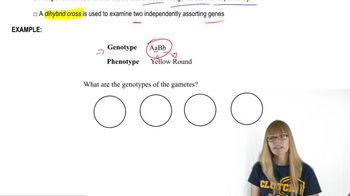
Mendelian inheritance describes how alleles segregate and assort independently during gamete formation. Independent assortment means genes located on different chromosomes are inherited separately, allowing combinations like ABO, Rh, and MN blood groups to be inherited independently. This principle helps predict offspring genotypes from parental genotypes.
Video consigliato:
Percorso guidato
04:58
Gamete Genetics and Independent Assortment

ABO Blood Group Genetics

The ABO blood group is determined by three alleles: I^A, I^B, and i. I^A and I^B are codominant, producing A and B antigens respectively, while i is recessive and produces type O blood. A person with blood type B can have genotypes I^B I^B or I^B i, which affects the possible blood types of their offspring.
Video consigliato:
Percorso guidato
11:35
History of Genetics

Rh and MN Blood Group Inheritance

The Rh blood group is controlled by two alleles: dominant R (Rh+) and recessive r (Rh−). Rh+ individuals can be homozygous (RR) or heterozygous (Rr). The MN blood group involves codominant alleles M and N, so heterozygotes express both antigens. Understanding these inheritance patterns is essential to determine possible blood types of children.
Video consigliato:
Percorso guidato
27:36
Diploid Genetics
Pratica correlata
Domanda del libro di testo

The ABO blood group assorts independently of the rhesus (Rh) blood group and both assort independently of the MN blood group. Three alleles, IA, IB and i, occur at the ABO locus. Two alleles, R, a dominant allele producing Rh+, and r, a recessive allele for Rh-, are found at the Rh locus, and codominant alleles M and N occur at the MN locus. Each gene is autosomal.

What proportion of children born to a man with genotype IAIB Rr MN and a woman who is IAi Rr NN will have blood types B, Rh- , and MN? Show your work.

421
views
Domanda del libro di testo

In rats, gene B produces black coat color if the genotype is , but black pigment is not produced if the genotype is bb. At an independent locus, gene D produces yellow pigment if the genotype is D-, but no pigment is produced when the genotype is dd. Production of both pigments results in brown coat color. If neither pigment is produced, coat color is cream. Determine the genotypes of parents of litters with the following phenotype distributions.


9 black, 7 brown

551
views
Domanda del libro di testo

Two genes interact to produce various phenotypic ratios among F₂ progeny of a dihybrid cross. Design a different pathway explaining each of the F₂ ratios below, using hypothetical genes R and T and assuming that the dominant allele at each locus catalyzes a different reaction or performs an action leading to pigment production. The recessive allele at each locus is null (loss-of-function). Begin each pathway with a colorless precursor that produces a white or albino phenotype if it is unmodified. The ratios are for F₂ progeny produced by crossing wild-type F₁ organisms with the genotype RrTt.

13/16 white : 3/16 green

403
views
Domanda del libro di testo

The ABO blood group assorts independently of the rhesus (Rh) blood group and both assort independently of the MN blood group. Three alleles, IA, IB and i, occur at the ABO locus. Two alleles, R, a dominant allele producing Rh+, and r, a recessive allele for Rh-, are found at the Rh locus, and codominant alleles M and N occur at the MN locus. Each gene is autosomal.

A child with blood types A, Rh−, and M is born to a woman who has blood types O, Rh−, and MN and a man who has blood types A, Rh+, and M. Determine the genotypes of each parent.

436
views
Domanda del libro di testo

In rats, gene B produces black coat color if the genotype is , but black pigment is not produced if the genotype is bb. At an independent locus, gene D produces yellow pigment if the genotype is D-, but no pigment is produced when the genotype is dd. Production of both pigments results in brown coat color. If neither pigment is produced, coat color is cream. Determine the genotypes of parents of litters with the following phenotype distributions.


4 brown, 4 black, 4 yellow, 4 cream

671
views
1
comments
Domanda del libro di testo

In rats, gene B produces black coat color if the genotype is , but black pigment is not produced if the genotype is bb. At an independent locus, gene D produces yellow pigment if the genotype is D-, but no pigment is produced when the genotype is dd. Production of both pigments results in brown coat color. If neither pigment is produced, coat color is cream. Determine the genotypes of parents of litters with the following phenotype distributions.


3 brown, 3 yellow, 1 black, 1 cream

675
views