Ch. 4 - Gene Interaction
Sanders - Genetic Analysis: An Integrated Approach 3rd Edition
Sanders3rd EditionGenetic Analysis: An Integrated ApproachISBN: 9780135564172Non è quello che usi tu?Cambia libro di testo
Capitolo 4, Problema 26a

Two pure-breeding strains of summer squash producing yellow fruit, Y₁ and Y₂, are each crossed to a pure-breeding strain of summer squash producing green fruit, G₁, and to one another. The following results are obtained:
Table showing summer squash crosses and fruit color ratios for genetics study.
Examine the results of each cross and predict how many genes are responsible for fruit-color determination in summer squash. Justify your answer. 

Guida verificata passo dopo passo
1
Examine the results of each cross in the table. Cross I shows that when Y₁ (yellow) is crossed with G₁ (green), the F₁ generation is all yellow, and the F₂ generation has a 3:1 ratio of yellow to green. This suggests a single gene with complete dominance, where yellow is dominant over green.
In Cross II, Y₂ (yellow) crossed with G₁ (green) produces an F₁ generation that is all green, and the F₂ generation has a 3:1 ratio of green to yellow. This indicates a single gene with complete dominance, but in this case, green is dominant over yellow. This suggests that Y₂ and G₁ involve a different gene than Y₁ and G₁.
In Cross III, Y₁ (yellow) crossed with Y₂ (yellow) produces an F₁ generation that is all yellow, and the F₂ generation has a 13:3 ratio of yellow to green. This ratio is characteristic of a dihybrid cross with epistasis, where two genes interact to determine the phenotype.
Based on the results of all three crosses, it can be concluded that two genes are responsible for fruit-color determination in summer squash. The first gene determines yellow or green color in Cross I, while the second gene determines green or yellow color in Cross II. The interaction between these two genes is evident in Cross III, where epistasis affects the phenotypic ratio.
To justify the conclusion, analyze the phenotypic ratios in the F₂ generations. The 3:1 ratios in Crosses I and II are consistent with Mendelian inheritance for single genes, while the 13:3 ratio in Cross III indicates a more complex interaction between two genes, confirming the involvement of two genes in fruit-color determination.

Risposta video verificata per un problema simile:

Questa soluzione video è stata consigliata dai nostri tutor come utile per risolvere questo problema.
Durata del video:
6m

Concetti chiave

Ecco i concetti essenziali che devi comprendere per rispondere correttamente alla domanda.

Mendelian Inheritance

Mendelian inheritance refers to the principles of heredity established by Gregor Mendel, which include the concepts of dominant and recessive traits. In this context, yellow fruit color is dominant over green. Understanding these principles helps in predicting the outcomes of genetic crosses and the ratios of phenotypes in the offspring.
Video consigliato:
Percorso guidato
05:13
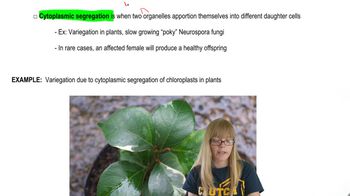
Organelle Inheritance

Phenotypic Ratios

Phenotypic ratios describe the relative frequencies of different phenotypes in the offspring resulting from a genetic cross. The ratios observed in the F2 generation of the crosses indicate how many genes may be involved in determining fruit color. Analyzing these ratios is crucial for deducing the genetic basis of the traits.
Video consigliato:
Percorso guidato
10:48
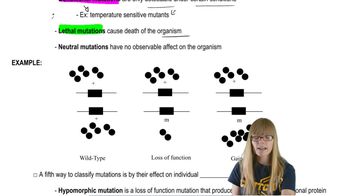
Mutations and Phenotypes

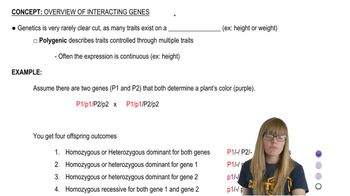
Gene Interaction

Gene interaction occurs when two or more genes influence a single trait, which can lead to complex inheritance patterns. In the case of summer squash, the varying ratios of yellow to green fruit in the F2 generation suggest that multiple genes may be involved in determining fruit color, necessitating an analysis of how these genes interact.
Video consigliato:
Percorso guidato
07:56
Interacting Genes Overview
Pratica correlata
Domanda del libro di testo

Marfan syndrome is an autosomal dominant disorder in humans. It results from mutation of a gene on chromosome 15 that produces the connective tissue protein fibrillin. In its wild-type form, fibrillin gives connective tissues, such as cartilage, elasticity. When mutated, however, fibrillin is rigid and produces a range of phenotypic complications, including excessive growth of the long bones of the leg and arm, sunken chest, dislocation of the lens of the eye, and susceptibility to aortic aneurysm, which can lead to sudden death in some cases. Different sets of symptoms are seen among various family members, as shown in the pedigree below. Each quadrant of the circles and squares represents a different symptom, as the key indicates.

All cases of Marfan syndrome are caused by mutation of the fibrillin gene, and all family members with Marfan syndrome carry the same mutant allele. What do the differences shown in the phenotypes of family members say about the expression of the mutant allele?

691
views
Domanda del libro di testo

Blue flower color is produced in a species of morning glories when dominant alleles are present at two gene loci, A and B. (Plants with the genotype have blue flowers.) Purple flowers result when a dominant allele is present at only one of the two gene loci, A or B. (Plants with the genotypes and are purple.) Flowers are red when the plant is homozygous recessive for each gene (i.e., aabb).

If an F₁ plant is backcrossed to one of the pure-breeding parental plants, what is the expected ratio of phenotypes among progeny? Why is the phenotype ratio the same regardless of which parental strain is selected for the backcross?

778
views
Domanda del libro di testo

Two pure-breeding strains of summer squash producing yellow fruit, Y₁ and Y₂, are each crossed to a pure-breeding strain of summer squash producing green fruit, G₁, and to one another. The following results are obtained:

Using clearly defined symbols of your choice, give the genotypes of parental, F₁, and F₂ plants in each cross. 

429
views
Domanda del libro di testo

Two pure-breeding strains of summer squash producing yellow fruit, Y₁ and Y₂, are each crossed to a pure-breeding strain of summer squash producing green fruit, G₁, and to one another. The following results are obtained:

If the F₁ of Crosses I and II are mated, predict the phenotype ratio of the progeny. 

532
views
Domanda del libro di testo

The crosses shown are performed between morning glories whose flower color is determined as described in Problem 24. Use the segregation data to determine the genotype of each parental plant.


513
views
Domanda del libro di testo

Blue flower color is produced in a species of morning glories when dominant alleles are present at two gene loci, A and B. (Plants with the genotype have blue flowers.) Purple flowers result when a dominant allele is present at only one of the two gene loci, A or B. (Plants with the genotypes and are purple.) Flowers are red when the plant is homozygous recessive for each gene (i.e., aabb).

If two F₁ plants are crossed, what are the expected phenotypes and frequencies in the F₂?

492
views