Ch. 5 - Genetic Linkage and Mapping in Eukaryotes
Sanders - Genetic Analysis: An Integrated Approach 3rd Edition
Sanders3rd EditionGenetic Analysis: An Integrated ApproachISBN: 9780135564172Non è quello che usi tu?Cambia libro di testo
Capitolo 5, Problema 2a

In a diploid species of plant, the genes for plant height and fruit shape are syntenic and separated by 18 m.u. Allele D produces tall plants and is dominant to d for short plants, and allele R produces round fruit and is dominant to r for oval fruit.


A plant with the genotype DR/dr produces gametes. Identify gamete genotypes, label parental and recombinant gametes, and give the frequency of each gamete genotype.

Guida verificata passo dopo passo
1
Understand the genetic setup: The plant is diploid with the genotype DR/dr, meaning it is heterozygous for both traits (plant height and fruit shape). The genes are syntenic (on the same chromosome) and separated by 18 map units (m.u.), which indicates a recombination frequency of 18% (0.18).
Determine the possible gamete genotypes: Since the plant is heterozygous (DR/dr), the possible gametes are DR, dr, Dr, and dR. DR and dr are the parental gametes because they retain the original arrangement of alleles on the chromosomes. Dr and dR are the recombinant gametes because they result from crossing over between the two genes.
Assign frequencies to the gametes: The recombination frequency of 18% means that 18% of the gametes will be recombinant (Dr and dR combined). Since recombination produces equal numbers of the two recombinant gametes, each recombinant gamete (Dr and dR) will have a frequency of 9% (0.09).
Calculate the frequency of parental gametes: The remaining 82% of the gametes will be parental (DR and dr combined). Since parental gametes are also produced in equal numbers, each parental gamete (DR and dr) will have a frequency of 41% (0.41).
Summarize the results: The gamete genotypes are DR (parental, 41%), dr (parental, 41%), Dr (recombinant, 9%), and dR (recombinant, 9%). These frequencies reflect the genetic linkage and recombination between the two syntenic genes.

Risposta video verificata per un problema simile:

Questa soluzione video è stata consigliata dai nostri tutor come utile per risolvere questo problema.
Durata del video:
2m

Concetti chiave

Ecco i concetti essenziali che devi comprendere per rispondere correttamente alla domanda.

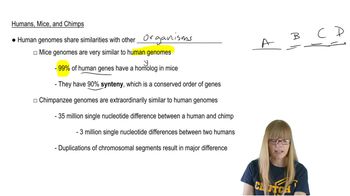
Synteny

Synteny refers to the conservation of gene order on chromosomes between different species or within the same species. In this context, it indicates that the genes for plant height and fruit shape are located on the same chromosome and are inherited together, which is crucial for understanding how these traits are passed on to the offspring.
Video consigliato:
Percorso guidato
01:49
Humans, Mice, and Chimps

Gamete Formation and Genotype

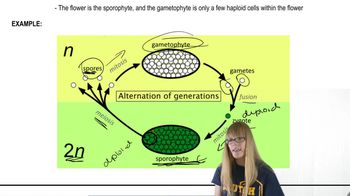
Gamete formation involves the process of meiosis, where diploid cells divide to produce haploid gametes. The genotype of the parent plant (DR/dr) will determine the combinations of alleles in the gametes. Understanding how alleles segregate during gamete formation is essential for predicting the genotypes of the resulting gametes.
Video consigliato:
Percorso guidato
04:06
Formation of Plant Gametes

Recombinant and Parental Gametes

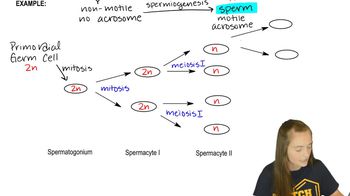
Parental gametes are those that carry the same allele combinations as the parents, while recombinant gametes result from crossing over during meiosis, leading to new allele combinations. Identifying these types of gametes is important for calculating their frequencies and understanding genetic variation in the offspring.
Video consigliato:
Percorso guidato
21:21
Gamete Development