Ch. 5 - Genetic Linkage and Mapping in Eukaryotes
Sanders - Genetic Analysis: An Integrated Approach 3rd Edition
Sanders3rd EditionGenetic Analysis: An Integrated ApproachISBN: 9780135564172Non è quello che usi tu?Cambia libro di testo
Capitolo 5, Problema 26b

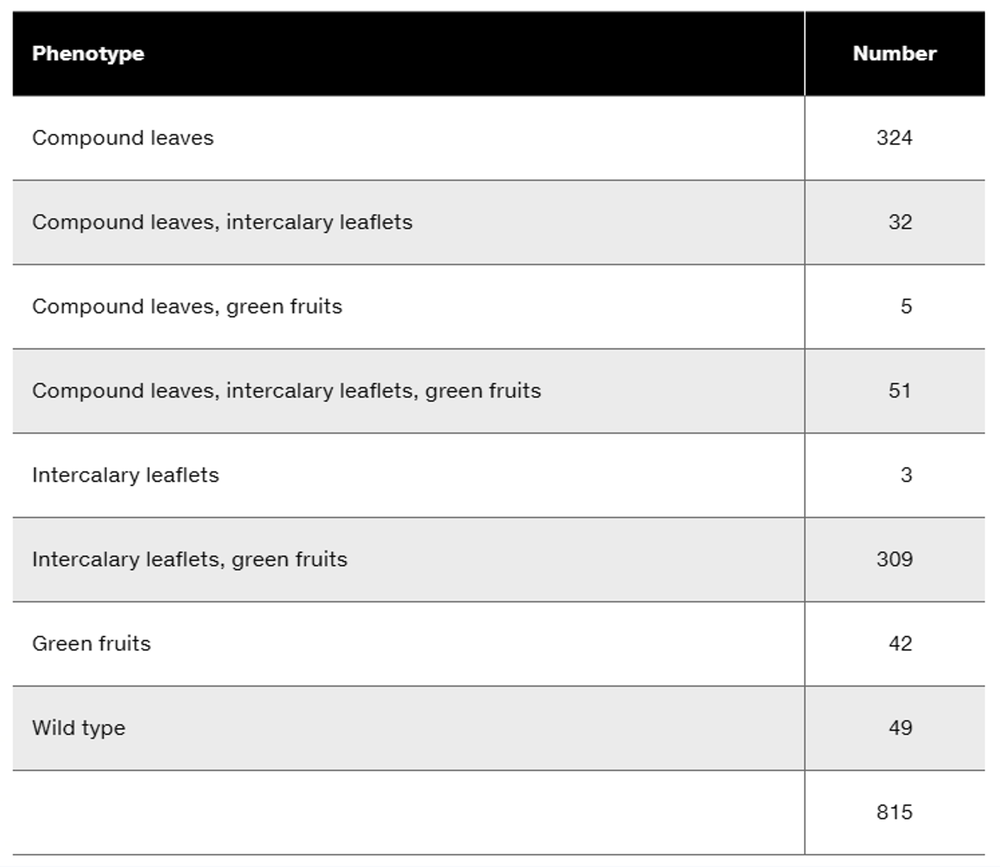
The following progeny are obtained from a test cross of a trihybrid wild-type plant to a plant with the recessive phenotypes compound leaves (c), intercalary leaflets (i), and green fruits (g). (Traits not listed are wild type.) The test-cross progeny are as follows:
Table displaying phenotypes and their corresponding numbers from a trihybrid test cross in plant genetics.
Calculate the frequencies of recombination between the adjacent genes in the map.

Guida verificata passo dopo passo
1
Step 1: Organize the data into categories based on phenotypes. Identify parental phenotypes (most frequent) and double crossover phenotypes (least frequent). This will help determine the gene order and recombination frequencies.
Step 2: Determine the gene order by comparing the double crossover phenotypes to the parental phenotypes. The gene that differs in the double crossover phenotypes is the middle gene.
Step 3: Calculate the recombination frequencies between adjacent genes. Use the formula: Number of recombinantsTotal number of progeny. Add the single crossover and double crossover progeny for each interval to calculate the recombination frequency.
Step 4: Convert the recombination frequencies into map units (centiMorgans, cM). Each 1% recombination frequency corresponds to 1 cM.
Step 5: Construct the genetic map by placing the genes in order and indicating the distances (in cM) between them based on the calculated recombination frequencies.

Risposta video verificata per un problema simile:

Questa soluzione video è stata consigliata dai nostri tutor come utile per risolvere questo problema.
Durata del video:
3m

Concetti chiave

Ecco i concetti essenziali che devi comprendere per rispondere correttamente alla domanda.

Test Cross

A test cross is a genetic cross between an individual with an unknown genotype and a homozygous recessive individual. This method helps determine the genotype of the unknown parent by analyzing the phenotypes of the offspring. In this case, the wild-type plant is crossed with a plant exhibiting recessive traits, allowing for the observation of trait inheritance patterns in the progeny.
Video consigliato:
Percorso guidato
26:08
Trihybrid Cross

Recombination Frequency

Recombination frequency is a measure of the likelihood that two genes will be separated during meiosis due to crossing over. It is calculated by dividing the number of recombinant offspring by the total number of offspring, often expressed as a percentage. This frequency is crucial for constructing genetic maps, as it indicates the relative distances between genes on a chromosome.
Video consigliato:
Percorso guidato
03:51
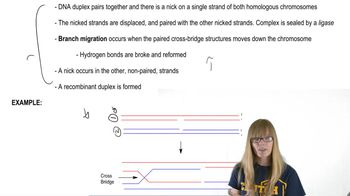
Recombination after Single Strand Breaks

Genetic Mapping

Genetic mapping is the process of determining the location and distance between genes on a chromosome. By analyzing recombination frequencies, researchers can create a genetic map that illustrates the arrangement of genes and their relative distances. This information is vital for understanding gene linkage and inheritance patterns, which can aid in breeding and genetic research.
Video consigliato:
Percorso guidato
11:11
Mapping Overview
Pratica correlata
Domanda del libro di testo

The following progeny are obtained from a test cross of a trihybrid wild-type plant to a plant with the recessive phenotypes compound leaves (c), intercalary leaflets (i), and green fruits (g). (Traits not listed are wild type.) The test-cross progeny are as follows:

How many double-crossover progeny are expected among the test-cross progeny? Calculate the interference for this cross.

746
views
Domanda del libro di testo

In rabbits, chocolate-colored fur (w⁺) is dominant to white fur (w), straight fur (c⁺) is dominant to curly fur (c), and long ear (s⁺) is dominant to short ear (s). The cross of a trihybrid rabbit with straight, chocolate-colored fur and long ears to a rabbit that has white, curly fur and short ears produces the following results:

Calculate the recombination frequencies between each of the adjacent pairs of genes.

499
views
Domanda del libro di testo

The following progeny are obtained from a test cross of a trihybrid wild-type plant to a plant with the recessive phenotypes compound leaves (c), intercalary leaflets (i), and green fruits (g). (Traits not listed are wild type.) The test-cross progeny are as follows:

Determine the order of the three genes, and construct a genetic map that identifies the correct order and the alleles carried on each chromosome in the trihybrid parental plant.

868
views
Domanda del libro di testo

In rabbits, chocolate-colored fur (w⁺) is dominant to white fur (w), straight fur (c⁺) is dominant to curly fur (c), and long ear (s⁺) is dominant to short ear (s). The cross of a trihybrid rabbit with straight, chocolate-colored fur and long ears to a rabbit that has white, curly fur and short ears produces the following results:

Determine the interference value for this cross.

404
views
Domanda del libro di testo

In tomatoes, the allele T for tall plant height is dominant to dwarf allele t, the P allele for smooth skin is dominant to the p allele for peach fuzz skin, and the allele R for round fruit is dominant to the recessive r allele for oblong fruit. The genes controlling these traits are linked on chromosome 1 in the tomato genome, and the genes are arranged in the order and with the recombination frequencies shown.

A pure-breeding tall, peach fuzz, round plant is crossed to a pure-breeding plant that is dwarf, smooth, oblong. What are the gamete genotypes produced by each of these plants? 

815
views
Domanda del libro di testo

In tomatoes, the allele T for tall plant height is dominant to dwarf allele t, the P allele for smooth skin is dominant to the p allele for peach fuzz skin, and the allele R for round fruit is dominant to the recessive r allele for oblong fruit. The genes controlling these traits are linked on chromosome 1 in the tomato genome, and the genes are arranged in the order and with the recombination frequencies shown.

What are the genotype and phenotype of the F₁ progeny of this cross?

414
views