Ch. 6 - Genetic Analysis and Mapping in Bacteria and Bacteriophages
Sanders - Genetic Analysis: An Integrated Approach 3rd Edition
Sanders3rd EditionGenetic Analysis: An Integrated ApproachISBN: 9780135564172Non è quello che usi tu?Cambia libro di testo
Capitolo 6, Problema 4

Bacteria transfer genes by conjugation, transduction, and transformation. Compare and contrast these mechanisms. In your answer, identify which if any processes involve homologous recombination and which if any do not.

Guida verificata passo dopo passo
1
Identify the three mechanisms of gene transfer in bacteria: conjugation, transduction, and transformation.
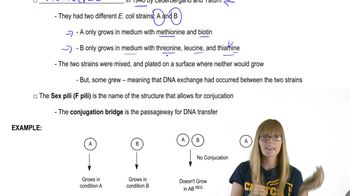
Explain conjugation: a process where genetic material is transferred between bacterial cells through direct contact, often involving a pilus. Note that homologous recombination can occur if the transferred DNA is integrated into the recipient's genome.
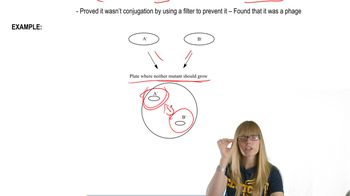
Describe transduction: a process where bacterial DNA is transferred from one bacterium to another by a virus (bacteriophage). Homologous recombination may occur if the DNA is integrated into the recipient's genome.
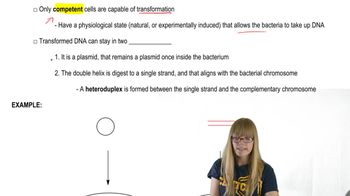
Discuss transformation: a process where bacteria take up free DNA from their environment. Homologous recombination is involved if the DNA is integrated into the bacterial chromosome.
Compare and contrast: Highlight that all three processes can involve homologous recombination if the transferred DNA is integrated into the recipient's genome, but the initial mechanisms of transfer differ (direct contact in conjugation, viral mediation in transduction, and environmental uptake in transformation).

Risposta video verificata per un problema simile:

Questa soluzione video è stata consigliata dai nostri tutor come utile per risolvere questo problema.
Durata del video:
2m

Concetti chiave

Ecco i concetti essenziali che devi comprendere per rispondere correttamente alla domanda.

Conjugation

Conjugation is a process where bacteria transfer genetic material through direct contact, typically via a pilus. This mechanism allows for the transfer of plasmids, which can carry antibiotic resistance genes. Conjugation does not inherently involve homologous recombination, as the transferred DNA can exist as an independent plasmid.
Video consigliato:
Percorso guidato
04:06
Conjugation Overview

Transduction

Transduction is the transfer of genetic material between bacteria via bacteriophages (viruses that infect bacteria). During this process, a bacteriophage can accidentally incorporate bacterial DNA and transfer it to another bacterium. This mechanism can involve homologous recombination if the transferred DNA integrates into the recipient's genome.
Video consigliato:

Transformation

Transformation is the uptake of free DNA from the environment by a bacterial cell. This process can occur naturally or be induced artificially in laboratory settings. Transformation can lead to homologous recombination if the incorporated DNA shares sequence similarity with the recipient's genome, allowing for genetic integration.
Video consigliato:
Pratica correlata
Domanda del libro di testo

Explain the importance of the following features in conjugating donor bacteria:

homologous recombination

609
views
Domanda del libro di testo

Go online to the Online Mendelian Inheritance of Man (OMIM) website. Look up the following genetic conditions and answer the questions posed about them.

Go to the 'Population Genetics' section discussing the TSD gene. In a few sentences, summarize the human population in which TSD is most frequently found and give the approximate frequency of heterozygous carriers for the TSD mutation in North American Jews.

574
views
Domanda del libro di testo

A couple comes into your genetic counseling practice with a question about the chance a future child of theirs might have a genetic disease. Three or four men in the woman's family, including her father, had a condition that might be genetic. Although her father is still alive, she has had little contact with him for much of her life and cannot describe or name the condition. Her partner is a healthy man whose family has no history indicating the presence of a genetic condition. To provide more information about this possible genetic condition for the couple, what is the first step you recommend?

472
views
Domanda del libro di testo

Explain the importance of the following features in conjugating donor bacteria:

the conjugation pilus

610
views
Domanda del libro di testo

Explain the importance of the following features in conjugating donor bacteria:

the origin of transfer

663
views
Domanda del libro di testo

Conjugation between an Hfr cell and an F⁻ cell does not usually result in conversion of exconjugants to the donor state. Occasionally, however, the result of this conjugation is two Hfr cells. Explain how this occurs.

1946
views