Ch. 7 - DNA Structure and Replication
Sanders - Genetic Analysis: An Integrated Approach 3rd Edition
Sanders3rd EditionGenetic Analysis: An Integrated ApproachISBN: 9780135564172Non è quello che usi tu?Cambia libro di testo
Capitolo 7, Problema 31

A PCR reaction begins with one double-stranded segment of DNA. How many double-stranded copies of DNA are present after the completion of 10 amplification cycles? After 20 cycles? After 30 cycles?

Guida verificata passo dopo passo
1
Understand the principle of PCR (Polymerase Chain Reaction): In each cycle of PCR, the number of double-stranded DNA molecules doubles. This is an exponential process, where the number of DNA molecules after n cycles can be calculated using the formula: \( N = N_0 \times 2^n \), where \( N_0 \) is the initial number of DNA molecules (in this case, 1), and \( n \) is the number of cycles.
Identify the given values: The initial number of DNA molecules \( N_0 \) is 1. You are asked to calculate the number of DNA molecules after 10, 20, and 30 cycles. These correspond to \( n = 10 \), \( n = 20 \), and \( n = 30 \).
Substitute the values into the formula for each case: For 10 cycles, the formula becomes \( N = 1 \times 2^{10} \). For 20 cycles, it becomes \( N = 1 \times 2^{20} \). For 30 cycles, it becomes \( N = 1 \times 2^{30} \).
Simplify the expressions: Use the properties of exponents to calculate \( 2^{10} \), \( 2^{20} \), and \( 2^{30} \). These values represent the number of double-stranded DNA molecules after the respective number of cycles.
Interpret the results: The calculated values represent the exponential growth of DNA molecules during PCR. This demonstrates how PCR can rapidly amplify DNA, making it a powerful tool in molecular biology.

Risposta video verificata per un problema simile:

Questa soluzione video è stata consigliata dai nostri tutor come utile per risolvere questo problema.
Durata del video:
1m

Concetti chiave

Ecco i concetti essenziali che devi comprendere per rispondere correttamente alla domanda.

Polymerase Chain Reaction (PCR)

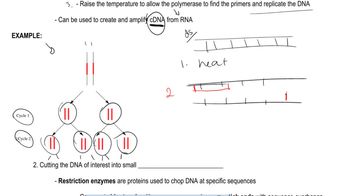
PCR is a molecular biology technique used to amplify specific segments of DNA. It involves repeated cycles of denaturation, annealing, and extension, allowing for exponential replication of the target DNA sequence. Each cycle theoretically doubles the amount of DNA, making it a powerful tool for genetic analysis.
Video consigliato:
Percorso guidato
07:39
Genetic Cloning

Exponential Growth in PCR

In PCR, the amount of DNA doubles with each cycle, leading to exponential growth. The formula to calculate the number of DNA copies after 'n' cycles is 2^n, where 'n' is the number of cycles. This means that after 10 cycles, there would be 2^10 (1,024) copies, after 20 cycles, 2^20 (1,048,576) copies, and after 30 cycles, 2^30 (1,073,741,824) copies.
Video consigliato:
Percorso guidato
04:17
Traditional vs. Next-Gen

Double-Stranded DNA

Double-stranded DNA consists of two complementary strands that form a helical structure. In the context of PCR, each cycle produces new double-stranded DNA molecules from the original template. Understanding the nature of double-stranded DNA is crucial for grasping how PCR amplifies genetic material effectively.
Video consigliato:
Percorso guidato
03:03
Double Strand Breaks