Ch. 7 - DNA Structure and Replication
Sanders - Genetic Analysis: An Integrated Approach 3rd Edition
Sanders3rd EditionGenetic Analysis: An Integrated ApproachISBN: 9780135564172Non è quello che usi tu?Cambia libro di testo
Capitolo 7, Problema 8c

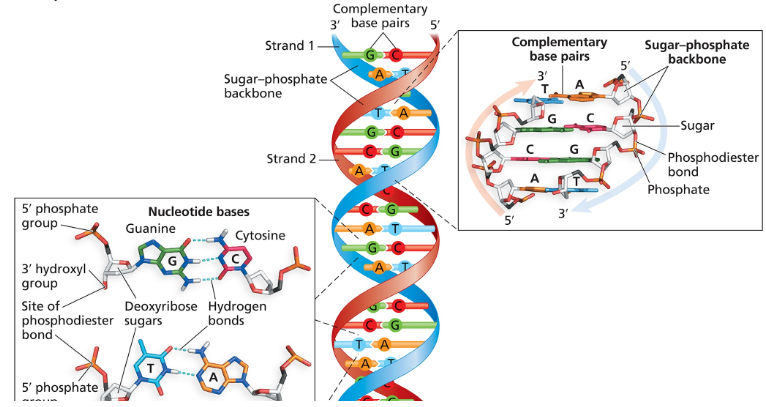
The following figure (Figure 1.6) presents simplified depictions of nucleotides containing deoxyribose, a nucleotide base, and a phosphate group. Use this simplified method of representation to illustrate the sequence 3'-AGTCGAT-5' and its complementary partner in a DNA duplex.

How many phosphodiester bonds are present in this DNA duplex?

Guida verificata passo dopo passo
1
Start by understanding the structure of a DNA nucleotide. Each nucleotide consists of three components: a deoxyribose sugar, a phosphate group, and a nitrogenous base (adenine, guanine, cytosine, or thymine).
Illustrate the given sequence 3'-AGTCGAT-5' by arranging the nucleotides in the correct order. Remember that the 3' and 5' ends refer to the carbon positions in the sugar molecule where the phosphate group is attached.
Determine the complementary sequence for the given strand. Use the base-pairing rules: adenine (A) pairs with thymine (T), and guanine (G) pairs with cytosine (C). The complementary strand will run in the opposite direction (5'-3').
Count the number of phosphodiester bonds in each strand. A phosphodiester bond connects the 3' carbon of one nucleotide's sugar to the 5' carbon of the next nucleotide's sugar via a phosphate group. For a strand with 'n' nucleotides, there are (n-1) phosphodiester bonds.
Since the DNA duplex consists of two strands, calculate the total number of phosphodiester bonds by summing the bonds in both strands. Ensure you account for the complementary strand's length, which matches the original strand.

Risposta video verificata per un problema simile:

Questa soluzione video è stata consigliata dai nostri tutor come utile per risolvere questo problema.
Durata del video:
1m

Concetti chiave

Ecco i concetti essenziali che devi comprendere per rispondere correttamente alla domanda.

Nucleotides

Nucleotides are the building blocks of DNA and RNA, consisting of three components: a sugar (deoxyribose in DNA), a phosphate group, and a nitrogenous base. In DNA, the sequence of these nucleotides encodes genetic information. Understanding the structure of nucleotides is essential for analyzing DNA sequences and their complementary pairs.
Video consigliato:

Complementary Base Pairing

Complementary base pairing refers to the specific pairing of nitrogenous bases in DNA, where adenine (A) pairs with thymine (T) and cytosine (C) pairs with guanine (G). This pairing is crucial for the formation of the double helix structure of DNA and ensures accurate replication and transcription of genetic information. Recognizing these pairs is vital for determining the complementary sequence of a given DNA strand.
Video consigliato:
Percorso guidato
03:49
Base Distortions

Phosphodiester Bonds

Phosphodiester bonds are covalent bonds that link nucleotides together in a DNA or RNA strand. They form between the phosphate group of one nucleotide and the hydroxyl group of the sugar of another, creating a sugar-phosphate backbone. The number of phosphodiester bonds in a DNA duplex can be calculated by counting the number of nucleotides in the strand and subtracting one, as each bond connects two nucleotides.
Video consigliato:
Pratica correlata
Domanda del libro di testo

The following figure (Figure 1.6) presents simplified depictions of nucleotides containing deoxyribose, a nucleotide base, and a phosphate group. Use this simplified method of representation to illustrate the sequence 3'-AGTCGAT-5' and its complementary partner in a DNA duplex.

What kind of bonds join the C in one strand to the G in the complementary strand?

488
views
Domanda del libro di testo

The following figure (Figure 1.6) presents simplified depictions of nucleotides containing deoxyribose, a nucleotide base, and a phosphate group. Use this simplified method of representation to illustrate the sequence 3'-AGTCGAT-5' and its complementary partner in a DNA duplex.

How many hydrogen bonds are present in this DNA duplex?

526
views
Domanda del libro di testo

Consider the sequence 3'-ACGCTACGTC-5'.

What is the double-stranded sequence?

661
views
Domanda del libro di testo

For the following fragment of DNA, determine the number of hydrogen bonds and the number of phosphodiester bonds present:

5'-ACGTAGAGTGCTC-3'

3'-TGCATCTCACGAG-5'

883
views
Domanda del libro di testo

Consider the sequence 3'-ACGCTACGTC-5'.

What is the total number of covalent bonds joining the nucleotides in each strand?

943
views
Domanda del libro di testo

The following figure (Figure 1.6) presents simplified depictions of nucleotides containing deoxyribose, a nucleotide base, and a phosphate group. Use this simplified method of representation to illustrate the sequence 3'-AGTCGAT-5' and its complementary partner in a DNA duplex.

What kind of bond joins the C to G within a single strand?

438
views