Ch. 7 - DNA Structure and Replication
Sanders - Genetic Analysis: An Integrated Approach 3rd Edition
Sanders3rd EditionGenetic Analysis: An Integrated ApproachISBN: 9780135564172Non è quello che usi tu?Cambia libro di testo
Capitolo 7, Problema 16e

Which of the following equations are true for the percentages of nucleotides in double-stranded DNA?
(A)/(G)=(T)(C)

Guida verificata passo dopo passo
1
Understand the context: In double-stranded DNA, the base pairing rules (Chargaff's rules) state that adenine (A) pairs with thymine (T) and guanine (G) pairs with cytosine (C). This means the amount of A equals T, and the amount of G equals C.
Analyze the given equation: The equation provided is (A)/(G) = (T)(C). This equation suggests a relationship between the percentages of the nucleotides in double-stranded DNA.
Check the left-hand side of the equation: The term (A)/(G) represents the ratio of adenine to guanine. According to Chargaff's rules, there is no direct proportionality between A and G, as A pairs with T and G pairs with C.
Check the right-hand side of the equation: The term (T)(C) represents the product of the percentages of thymine and cytosine. Again, there is no direct relationship between T and C in terms of multiplication, as T pairs with A and C pairs with G.
Conclude the validity of the equation: Based on Chargaff's rules, the equation (A)/(G) = (T)(C) does not hold true for double-stranded DNA. The relationships between nucleotide percentages are A = T and G = C, not the given equation.

Risposta video verificata per un problema simile:

Questa soluzione video è stata consigliata dai nostri tutor come utile per risolvere questo problema.
Durata del video:
4m

Concetti chiave

Ecco i concetti essenziali che devi comprendere per rispondere correttamente alla domanda.

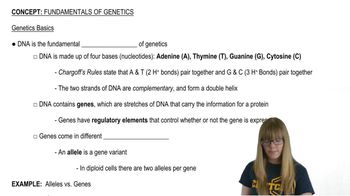
Chargaff's Rules

Chargaff's Rules state that in double-stranded DNA, the amount of adenine (A) equals thymine (T), and the amount of guanine (G) equals cytosine (C). This means that A pairs with T and G pairs with C, leading to a specific ratio of these nucleotides in the DNA structure. Understanding these rules is essential for analyzing nucleotide percentages.
Video consigliato:
Percorso guidato
08:44
Genetics Basics

Base Pairing

Base pairing refers to the specific hydrogen bonding between nucleotides in DNA, where adenine pairs with thymine and guanine pairs with cytosine. This complementary pairing is crucial for the stability of the DNA double helix and ensures accurate replication and transcription. Recognizing base pairing is vital for interpreting nucleotide ratios.
Video consigliato:
Percorso guidato
03:49
Base Distortions

Nucleotide Composition

Nucleotide composition in DNA refers to the relative amounts of the four nucleotides: adenine, thymine, guanine, and cytosine. In double-stranded DNA, the total percentage of A and T should equal that of G and C due to base pairing. This composition is fundamental for understanding the equations related to nucleotide percentages.
Video consigliato:
Percorso guidato
06:51
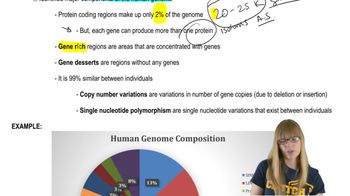
Human Genome Composition