Ch. 8 - Molecular Biology of Transcription and RNA Processing
Sanders - Genetic Analysis: An Integrated Approach 3rd Edition
Sanders3rd EditionGenetic Analysis: An Integrated ApproachISBN: 9780135564172Non è quello che usi tu?Cambia libro di testo
Capitolo 8, Problema 23a

Microbiologists describe the processes of transcription and translation as 'coupled' in bacteria. This term indicates that a bacterial mRNA can be undergoing transcription at the same moment it is also undergoing translation.
How is coupling of transcription and translation possible in bacteria?

Guida verificata passo dopo passo
1
Understand the structure of bacterial cells: Bacteria are prokaryotic organisms, meaning they lack a nucleus. This structural difference is key to understanding how transcription and translation can occur simultaneously.
Recognize the spatial arrangement: In bacteria, the DNA is located in the cytoplasm, not enclosed within a nuclear membrane. This allows the processes of transcription and translation to occur in the same cellular compartment.
Learn about transcription: During transcription, RNA polymerase synthesizes mRNA directly from the DNA template. In bacteria, this process happens in the cytoplasm, where ribosomes are also present.
Understand translation initiation: As soon as the mRNA begins to emerge from the RNA polymerase during transcription, ribosomes can immediately bind to the mRNA and start translating it into a protein. This is possible because there is no physical barrier (like a nuclear membrane) separating the two processes.
Appreciate the efficiency of coupling: The coupling of transcription and translation in bacteria allows for rapid gene expression, which is advantageous for responding quickly to environmental changes. This is a hallmark of bacterial gene regulation and efficiency.

Risposta video verificata per un problema simile:

Questa soluzione video è stata consigliata dai nostri tutor come utile per risolvere questo problema.
Durata del video:
2m

Concetti chiave

Ecco i concetti essenziali che devi comprendere per rispondere correttamente alla domanda.

Transcription

Transcription is the process by which the genetic information encoded in DNA is copied into messenger RNA (mRNA). In bacteria, this occurs in the cytoplasm, where RNA polymerase synthesizes mRNA from a DNA template. This process is crucial for gene expression, as it produces the mRNA that will later be translated into proteins.
Video consigliato:
Percorso guidato
09:16
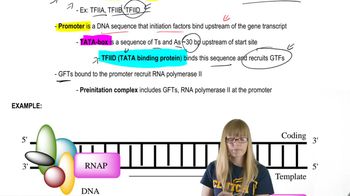
Eukaryotic Transcription

Translation

Translation is the process by which ribosomes synthesize proteins using the mRNA transcript as a template. In bacteria, ribosomes can attach to the mRNA while it is still being synthesized, allowing for immediate translation of the mRNA into a polypeptide chain. This efficiency is vital for bacterial survival and rapid response to environmental changes.
Video consigliato:
Percorso guidato
07:58
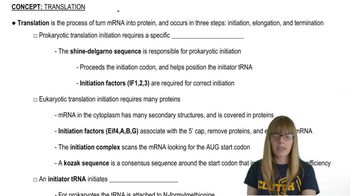
Translation initiation

Coupling of Transcription and Translation

In bacteria, transcription and translation are coupled due to the lack of a nuclear membrane, allowing ribosomes to bind to mRNA as it is being transcribed. This simultaneous process enables rapid protein synthesis, as the mRNA does not need to be fully processed before translation begins. This coupling is a key feature of prokaryotic gene expression, enhancing the efficiency of protein production.
Video consigliato:
Percorso guidato
07:58
Translation initiation
Pratica correlata
Domanda del libro di testo

The accompanying illustration shows a portion of a gene undergoing transcription. The template and coding strands for the gene are labeled, and a segment of DNA sequence is given.

For this gene segment, superimpose a drawing of RNA polymerase as it nears the end of transcription of the DNA sequence.

734
views
Domanda del libro di testo

A full-length eukaryotic gene is inserted into a bacterial chromosome. The gene contains a complete promoter sequence and a functional polyadenylation sequence, and it has wild-type nucleotides throughout the transcribed region. However, the gene fails to produce a functional protein. List at least three possible reasons why this eukaryotic gene is not expressed in bacteria.

499
views
Domanda del libro di testo

The human β-globin wild-type allele and a certain mutant allele are identical in sequence except for a single base-pair substitution that changes one nucleotide at the end of intron 2. The wild-type and mutant sequences of the affected portion of pre-mRNA are

This is one example of how DNA sequence change occurring somewhere other than in an exon can produce mutation. List other kinds of DNA sequence changes occurring outside exons that can produce mutation. In each case, characterize the kind of change you would expect to see in mutant mRNA or mutant protein.

492
views
Domanda del libro di testo

The human β-globin wild-type allele and a certain mutant allele are identical in sequence except for a single base-pair substitution that changes one nucleotide at the end of intron 2. The wild-type and mutant sequences of the affected portion of pre-mRNA are

Speculate about the way in which this base substitution causes mutation of β-globin protein.

502
views
Domanda del libro di testo

A mutant strain of Salmonella bacteria carries a mutation of the rho protein that has full activity at 37°C but is completely inactivated when the mutant strain is grown at 40°C. Are all mRNAs affected by the rho protein mutation in the same way? Why or why not?

503
views
Domanda del libro di testo

A full-length eukaryotic gene is inserted into a bacterial chromosome. The gene contains a complete promoter sequence and a functional polyadenylation sequence, and it has wild-type nucleotides throughout the transcribed region. However, the gene fails to produce a functional protein. What changes would you recommend to permit expression of this eukaryotic gene in a bacterial cell?

382
views