Ch. 9 - The Molecular Biology of Translation
Sanders - Genetic Analysis: An Integrated Approach 3rd Edition
Sanders3rd EditionGenetic Analysis: An Integrated ApproachISBN: 9780135564172Non è quello che usi tu?Cambia libro di testo
Capitolo 9, Problema 18

After completing Problem 17, carefully draw a line below the mRNA to represent its polypeptide product in accurate alignment with the mRNA. Label the N-terminal and C-terminal ends of the polypeptide. Carefully draw two lines above and parallel to the mRNA, and label them 'coding strand' and 'template strand.' Locate the DNA promoter sequence. Identify the locations of the  nucleotide and of a transcription termination sequence.

Guida verificata passo dopo passo
1
Identify the mRNA sequence from Problem 17 and note its 5' to 3' direction.
Draw a line below the mRNA sequence to represent the polypeptide chain, aligning each codon with its corresponding amino acid.
Label the N-terminal (amino end) at the start of the polypeptide and the C-terminal (carboxyl end) at the end.
Draw two lines above the mRNA: one for the 'coding strand' (5' to 3') and one for the 'template strand' (3' to 5').
Locate the DNA promoter sequence upstream of the mRNA start site and identify the transcription termination sequence downstream.

Risposta video verificata per un problema simile:

Questa soluzione video è stata consigliata dai nostri tutor come utile per risolvere questo problema.
Durata del video:
1m

Concetti chiave

Ecco i concetti essenziali che devi comprendere per rispondere correttamente alla domanda.

Transcription

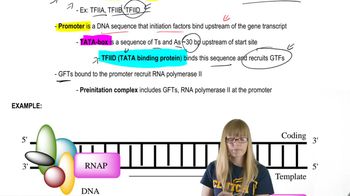
Transcription is the process by which the genetic information encoded in DNA is copied into messenger RNA (mRNA). This occurs in the nucleus of eukaryotic cells, where RNA polymerase binds to the promoter region of a gene, unwinding the DNA and synthesizing a complementary RNA strand. Understanding transcription is crucial for accurately representing the relationship between DNA and mRNA in the context of gene expression.
Video consigliato:
Percorso guidato
09:16
Eukaryotic Transcription

Polypeptide Structure

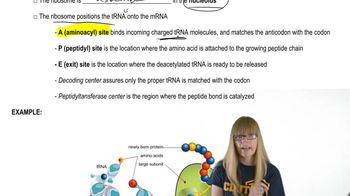
A polypeptide is a chain of amino acids linked by peptide bonds, which is synthesized during translation based on the sequence of codons in mRNA. The polypeptide has distinct ends: the N-terminal (amino end) and the C-terminal (carboxyl end), which are important for its function and folding. Recognizing these structural features is essential for accurately labeling the polypeptide product derived from the mRNA.
Video consigliato:
Percorso guidato
03:49
Ribosome Structure

DNA Strands

In the context of transcription, DNA consists of two strands: the coding strand and the template strand. The coding strand has the same sequence as the mRNA (except for thymine being replaced by uracil), while the template strand is complementary to the mRNA and serves as the actual template for RNA synthesis. Identifying these strands is vital for understanding how genetic information is transcribed and how the promoter and termination sequences function in this process.
Video consigliato:
Percorso guidato
03:03
Double Strand Breaks