Ch. 9 - The Molecular Biology of Translation
Sanders - Genetic Analysis: An Integrated Approach 3rd Edition
Sanders3rd EditionGenetic Analysis: An Integrated ApproachISBN: 9780135564172Non è quello che usi tu?Cambia libro di testo
Capitolo 9, Problema 39a

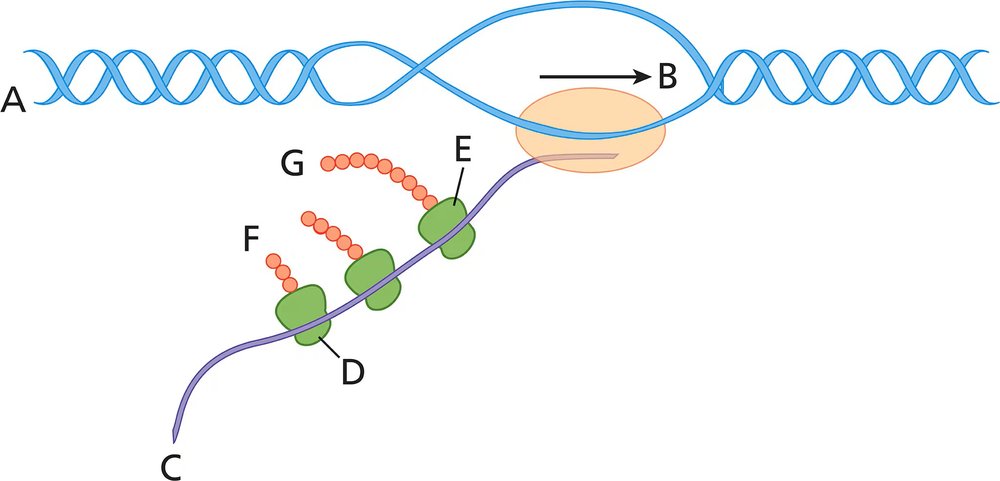
Answer the following questions about the accompanying diagram.
Diagram illustrating DNA strands, transcription process, and associated components labeled A to G.
Is the DNA nearest A the template strand or the coding strand?

Guida verificata passo dopo passo
1
Step 1: Understand the difference between the template strand and the coding strand. The template strand is the DNA strand that serves as a template for RNA synthesis during transcription. The coding strand, also known as the non-template strand, has the same sequence as the RNA transcript (except thymine is replaced by uracil in RNA).
Step 2: Examine the accompanying diagram carefully. Look for any labels or indications that specify the direction of transcription or the strand being used as a template.
Step 3: Identify the strand nearest to point A in the diagram. Determine whether it is being used as the template for RNA synthesis or if it matches the sequence of the RNA transcript.
Step 4: If the strand nearest to point A is complementary to the RNA sequence being synthesized, it is the template strand. If it matches the RNA sequence (except for uracil replacing thymine), it is the coding strand.
Step 5: Confirm your answer by checking for additional clues in the diagram, such as the presence of RNA polymerase or the direction of transcription, which can help clarify the role of the strand nearest to point A.

Risposta video verificata per un problema simile:

Questa soluzione video è stata consigliata dai nostri tutor come utile per risolvere questo problema.
Durata del video:
2m

Concetti chiave

Ecco i concetti essenziali che devi comprendere per rispondere correttamente alla domanda.

Template Strand vs. Coding Strand

In DNA transcription, the template strand is the strand that RNA polymerase uses to synthesize RNA, while the coding strand has the same sequence as the RNA (except for thymine being replaced by uracil). Understanding which strand is which is crucial for interpreting genetic information and predicting the resulting RNA sequence.
Video consigliato:
Percorso guidato
03:03
Double Strand Breaks

Directionality of DNA Strands

DNA strands have directionality, indicated as 5' to 3' and 3' to 5'. The template strand is read in the 3' to 5' direction during transcription, allowing RNA to be synthesized in the 5' to 3' direction. Recognizing this directionality is essential for determining the roles of the strands in transcription.
Video consigliato:

Role of Promoters in Transcription

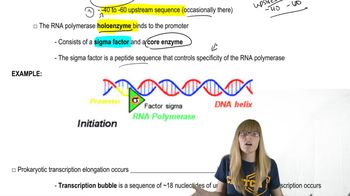
Promoters are specific DNA sequences located upstream of a gene that signal the start of transcription. They are crucial for the binding of RNA polymerase and the initiation of RNA synthesis. Identifying the promoter region helps in understanding which strand is the template strand based on the transcription start site.
Video consigliato:
Percorso guidato
10:14
Prokaryotic Transcription