Ch. 9 - The Molecular Biology of Translation
Sanders - Genetic Analysis: An Integrated Approach 3rd Edition
Sanders3rd EditionGenetic Analysis: An Integrated ApproachISBN: 9780135564172Non è quello che usi tu?Cambia libro di testo
Capitolo 9, Problema 12a

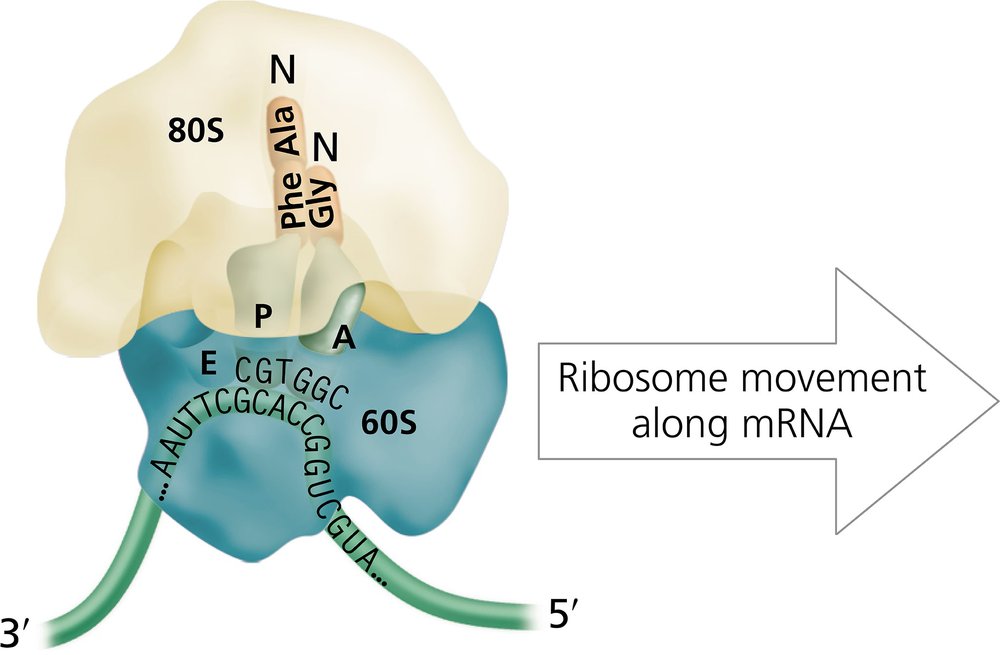
The diagram of a eukaryotic ribosome shown below contains several errors.
Diagram of a eukaryotic ribosome with labeled sites and an arrow indicating movement along mRNA, highlighting errors.
Examine the diagram carefully, and identify each error.

Guida verificata passo dopo passo
1
Carefully examine the diagram of the eukaryotic ribosome provided in the problem. Identify the key components of a eukaryotic ribosome, such as the large subunit (60S), small subunit (40S), mRNA, tRNA, and the A (aminoacyl), P (peptidyl), and E (exit) sites.
Compare the labels and structures in the diagram to the correct organization of a eukaryotic ribosome. Check if the subunits are labeled correctly (e.g., 60S and 40S for eukaryotes, not 50S and 30S, which are prokaryotic).
Verify the placement of the A, P, and E sites within the ribosome. Ensure that the A site is where the aminoacyl-tRNA enters, the P site is where the peptide bond forms, and the E site is where the tRNA exits.
Check the orientation of the mRNA strand in the diagram. Ensure that the mRNA is correctly positioned to be read in the 5' to 3' direction by the ribosome.
Identify any other structural or labeling errors, such as incorrect depiction of tRNA binding, peptide bond formation, or the ribosome's interaction with the mRNA and associated factors.

Risposta video verificata per un problema simile:

Questa soluzione video è stata consigliata dai nostri tutor come utile per risolvere questo problema.
Durata del video:
3m

Concetti chiave

Ecco i concetti essenziali che devi comprendere per rispondere correttamente alla domanda.

Eukaryotic Ribosome Structure

Eukaryotic ribosomes are complex molecular machines composed of ribosomal RNA (rRNA) and proteins. They consist of two subunits: the large subunit (60S) and the small subunit (40S), which come together during protein synthesis. Understanding the structure is crucial for identifying errors in diagrams, as each component plays a specific role in translation.
Video consigliato:
Percorso guidato
03:49
Ribosome Structure

Ribosomal RNA (rRNA)

Ribosomal RNA (rRNA) is a fundamental component of ribosomes, providing structural support and catalyzing peptide bond formation during protein synthesis. In eukaryotes, rRNA is transcribed from ribosomal DNA and is essential for the proper assembly and function of ribosomal subunits. Errors in the representation of rRNA can lead to misunderstandings about ribosome function.
Video consigliato:

Translation Process

Translation is the process by which ribosomes synthesize proteins by decoding messenger RNA (mRNA) sequences. This involves the sequential addition of amino acids to a growing polypeptide chain, guided by the mRNA template. Recognizing errors in a ribosome diagram requires an understanding of how the ribosome interacts with mRNA and transfer RNA (tRNA) during this critical biological process.
Video consigliato:
Percorso guidato
08:39
mRNA Processing
Pratica correlata
Domanda del libro di testo

If you were to look up Gaucher disease on the OMIM website, you would see that there are three major types, designated Type I (OMIM 230800), Type II (OMIM 230900), and Type III (OMIM 231000). All three types are mutations of the gene for acid-β-glucosidase, encoded on chromosome 1. Different mutations of this gene produce the three types of Gaucher disease that differ somewhat in their symptoms and disease severity.

For each mutation, speculate about whether the acid-β-glucosidase enzyme is merely reduced in function or whether its production is eliminated, and explain why.

491
views
Domanda del libro di testo

If you were to look up Gaucher disease on the OMIM website, you would see that there are three major types, designated Type I (OMIM 230800), Type II (OMIM 230900), and Type III (OMIM 231000). All three types are mutations of the gene for acid-β-glucosidase, encoded on chromosome 1. Different mutations of this gene produce the three types of Gaucher disease that differ somewhat in their symptoms and disease severity.

Thinking about the production or function of the acid-β-glucosidase enzyme, why do you suppose different mutations of this gene produce differences in symptoms and disease severity?

628
views
Domanda del libro di testo

Consider translation of the following mRNA sequence:

5′-...AUGCAGAUCCAUGCCUAUUGA...-3′

What events occur to permit the next tRNA to interact with mRNA?

490
views
Domanda del libro di testo

Third-base wobble allows some tRNAs to recognize more than one mRNA codon. Based on this chapter's discussion of wobble, what is the minimal number of tRNA molecules necessary to recognize the following amino acids?

Arginine

592
views
Domanda del libro di testo

The diagram of a eukaryotic ribosome shown below contains several errors.

Redraw the diagram, and correct each error using the mRNA sequence shown.

464
views
Domanda del libro di testo

Third-base wobble allows some tRNAs to recognize more than one mRNA codon. Based on this chapter's discussion of wobble, what is the minimal number of tRNA molecules necessary to recognize the following amino acids?

Leucine

1255
views