Ch.10 Proteins Workers of the Cell
Frost - General, Organic and Biological Chemistry 4th Edition
Frost4th EditionGeneral, Organic and Biological ChemistryISBN: 9780134988696Non è quello che usi tu?Cambia libro di testo
Capitolo 6, Problema 91b

Does each of the following statements describe a simple enzyme (no cofactor or coenzyme necessary), an enzyme that requires a cofactor, or an enzyme that requires a coenzyme?
b. consists of one polypeptide chain in its active form

Guida verificata passo dopo passo
1
Understand the definitions: A simple enzyme consists only of a protein (polypeptide chain) and does not require any additional molecules like cofactors or coenzymes for its activity. An enzyme requiring a cofactor needs a non-protein molecule (often a metal ion) to function. An enzyme requiring a coenzyme needs an organic molecule (often derived from vitamins) to assist in its activity.
Analyze the statement: The problem states that the enzyme consists of one polypeptide chain in its active form. This suggests that the enzyme is functional without requiring additional molecules.
Relate the statement to the definitions: Since the enzyme is active with just its polypeptide chain, it matches the description of a simple enzyme, which does not require cofactors or coenzymes.
Confirm the reasoning: A simple enzyme is characterized by its ability to function independently of cofactors or coenzymes. The statement aligns with this definition.
Conclude: Based on the analysis, the enzyme described in the statement is a simple enzyme.

Risposta video verificata per un problema simile:

Questa soluzione video è stata consigliata dai nostri tutor come utile per risolvere questo problema.
Durata del video:
3m

Concetti chiave

Ecco i concetti essenziali che devi comprendere per rispondere correttamente alla domanda.

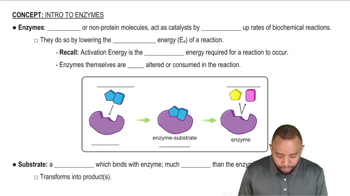
Simple Enzyme

A simple enzyme is a protein that functions as a catalyst in biochemical reactions without the need for any additional non-protein molecules, such as cofactors or coenzymes. These enzymes are typically composed solely of polypeptide chains and can catalyze reactions independently. An example of a simple enzyme is lysozyme, which breaks down bacterial cell walls.
Video consigliato:
Percorso guidato
2:14
Intro to Enzymes Concept 1

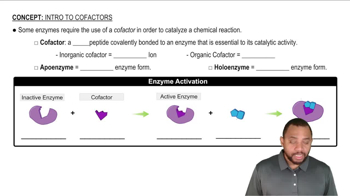
Cofactor

A cofactor is a non-protein chemical compound that is required for the biological activity of an enzyme. Cofactors can be metal ions, such as zinc or magnesium, or small organic molecules that assist in enzyme function. They often help stabilize enzyme structure or participate in the catalytic process, making them essential for the enzyme's activity.
Video consigliato:
Percorso guidato
2:39
Intro to Cofactors Concept 1

Coenzyme

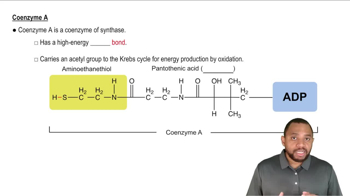
A coenzyme is a specific type of cofactor that is an organic molecule, often derived from vitamins, which assists enzymes in catalyzing reactions. Coenzymes typically bind to the enzyme temporarily and are involved in the transfer of chemical groups during the reaction. Examples include NAD+ and coenzyme A, which play crucial roles in metabolic pathways.
Video consigliato:
Percorso guidato
1:02
Coenzyme A Concept 4