
Ch.10 Proteins Workers of the Cell
Frost - General, Organic and Biological Chemistry 4th Edition
Frost4th EditionGeneral, Organic and Biological ChemistryISBN: 9780134988696Non è quello che usi tu?Cambia libro di testo
Capitolo 6, Problema 99

How does an irreversible inhibitor function differently than a reversible inhibitor?

Guida verificata passo dopo passo
1
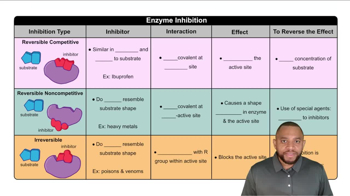
Irreversible inhibitors bind permanently to an enzyme, often through covalent bonds, leading to a permanent loss of enzyme activity.
Reversible inhibitors bind temporarily to an enzyme, usually through non-covalent interactions, and can be removed, allowing the enzyme to regain activity.
Irreversible inhibition often involves the inhibitor reacting with an amino acid residue at the active site of the enzyme, forming a stable complex.
Reversible inhibitors can be competitive, non-competitive, or uncompetitive, each affecting enzyme activity in different ways depending on their binding site and mechanism.
In the case of irreversible inhibitors, the enzyme's function is permanently altered, whereas reversible inhibitors allow for regulation of enzyme activity based on the concentration of the inhibitor.

Risposta video verificata per un problema simile:

Questa soluzione video è stata consigliata dai nostri tutor come utile per risolvere questo problema.
Durata del video:
6m

Concetti chiave

Ecco i concetti essenziali che devi comprendere per rispondere correttamente alla domanda.

Irreversible Inhibitors

Irreversible inhibitors bind permanently to an enzyme, often through covalent bonds, leading to a permanent loss of enzymatic activity. This type of inhibition typically results in a decrease in the total number of active enzyme molecules available for catalysis, as the inhibitor modifies the enzyme's structure, rendering it inactive.
Video consigliato:
Percorso guidato
3:26
Enzyme Inhibition Concept 2

Reversible Inhibitors

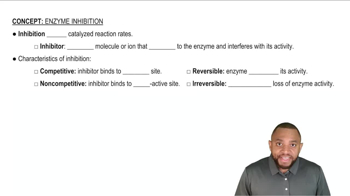
Reversible inhibitors bind to enzymes through non-covalent interactions, such as hydrogen bonds or ionic interactions, allowing them to dissociate from the enzyme. This means that the inhibition can be reversed, and the enzyme can regain its activity once the inhibitor is removed, making this type of inhibition more dynamic and dependent on the concentration of the inhibitor.
Video consigliato:
Percorso guidato
3:26
Enzyme Inhibition Concept 2

Mechanisms of Inhibition

The mechanisms of inhibition refer to how inhibitors affect enzyme activity. Irreversible inhibitors typically cause permanent changes to the enzyme's active site, while reversible inhibitors can compete with substrates or bind to allosteric sites, altering the enzyme's function without permanently modifying its structure. Understanding these mechanisms is crucial for drug design and enzyme regulation.
Video consigliato:
Percorso guidato
1:19
Enzyme Inhibition Concept 1