Ch.10 Proteins Workers of the Cell
Frost - General, Organic and Biological Chemistry 4th Edition
Frost4th EditionGeneral, Organic and Biological ChemistryISBN: 9780134988696Non è quello che usi tu?Cambia libro di testo
Capitolo 6, Problema 110b

Insulin is a protein hormone that functions as two polypeptide chains whose amino acid sequences are as follows:
A chain: GIVEQCCTSICSLTQLENYCN
B chain: FVNQHLCGDHLVEALYLV CGERGFFYTPKT
b. Considering the amino acid sequences, suggest how these two polypeptide chains might be held together in an active insulin molecule.

Guida verificata passo dopo passo
1
Identify the types of interactions that can occur between amino acids in polypeptide chains. These include hydrogen bonds, ionic bonds, hydrophobic interactions, and disulfide bridges.
Examine the amino acid sequences of the A and B chains for cysteine (C) residues, as these can form disulfide bridges, which are covalent bonds that can link different parts of a protein or different polypeptide chains.
Note that the A chain contains cysteine residues at positions 6 and 20, and the B chain contains cysteine residues at positions 7 and 19.
Propose that disulfide bridges could form between cysteine residues in the A and B chains, specifically between A6 and B7, and A20 and B19, helping to stabilize the active insulin structure.
Consider other interactions such as hydrogen bonds and hydrophobic interactions that might also contribute to the overall stability and conformation of the insulin molecule.

Risposta video verificata per un problema simile:

Questa soluzione video è stata consigliata dai nostri tutor come utile per risolvere questo problema.
Durata del video:
4m

Concetti chiave

Ecco i concetti essenziali che devi comprendere per rispondere correttamente alla domanda.

Protein Structure

Proteins are composed of amino acids linked by peptide bonds, forming polypeptide chains. The structure of a protein is crucial for its function, and it typically exists in four levels: primary (amino acid sequence), secondary (local folding patterns), tertiary (overall 3D shape), and quaternary (assembly of multiple polypeptide chains). In the case of insulin, understanding how the A and B chains interact is essential for grasping its functionality.
Video consigliato:
Percorso guidato
3:26
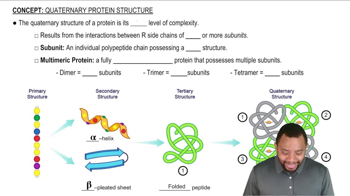
Quaternary Protein Structure Concept 1

Disulfide Bonds

Disulfide bonds are covalent linkages formed between the sulfur atoms of cysteine residues in proteins. These bonds play a critical role in stabilizing the three-dimensional structure of proteins, particularly in secreted proteins like insulin. In insulin, disulfide bonds between the A and B chains help maintain its active conformation, ensuring proper biological activity.
Video consigliato:

Protein Folding and Function

The process of protein folding is vital for the biological activity of proteins, as the specific shape of a protein determines its function. In insulin, the correct folding of the A and B chains, facilitated by interactions such as hydrogen bonds, hydrophobic interactions, and disulfide bonds, is necessary for its role in glucose regulation. Understanding how these chains come together provides insight into insulin's mechanism of action.
Video consigliato:
Percorso guidato
02:16
Logarithmic Functions