Ch.10 Proteins Workers of the Cell
Frost - General, Organic and Biological Chemistry 4th Edition
Frost4th EditionGeneral, Organic and Biological ChemistryISBN: 9780134988696Non è quello che usi tu?Cambia libro di testo
Capitolo 6, Problema 96

Problems 10.94 and 10.95 both mention enzymes that hydrolyze peptide bonds. How do you account for the fact that pepsin has a high catalytic activity at pH 1.5 but chymotrypsin has very little activity at pH 1.5?

Guida verificata passo dopo passo
1
Understand the concept of enzyme activity and how it is influenced by pH. Enzymes are proteins that act as catalysts, and their activity depends on the structure of their active site, which can be affected by pH levels.
Recognize that pepsin and chymotrypsin are enzymes that hydrolyze peptide bonds, but they function optimally at different pH levels due to their distinct structures and environments in the body.
Note that pepsin is active in the stomach, where the pH is highly acidic (around 1.5). Its structure is adapted to function in this environment, maintaining its active site configuration at low pH levels.
Understand that chymotrypsin operates in the small intestine, where the pH is closer to neutral (around 7-8). At a pH of 1.5, the structure of chymotrypsin's active site is disrupted, leading to very little catalytic activity.
Conclude that the difference in catalytic activity at pH 1.5 is due to the specific adaptations of each enzyme to their physiological environments, with pepsin being suited for acidic conditions and chymotrypsin for neutral conditions.

Risposta video verificata per un problema simile:

Questa soluzione video è stata consigliata dai nostri tutor come utile per risolvere questo problema.
Durata del video:
5m

Concetti chiave

Ecco i concetti essenziali che devi comprendere per rispondere correttamente alla domanda.

Enzyme Catalysis

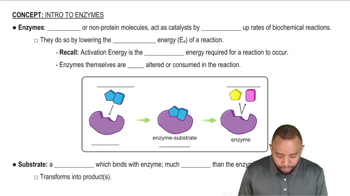
Enzyme catalysis refers to the process by which enzymes accelerate chemical reactions. Enzymes lower the activation energy required for reactions, allowing them to occur more rapidly. The efficiency of an enzyme is influenced by various factors, including pH, temperature, and substrate concentration. Understanding how these factors affect enzyme activity is crucial for analyzing their function in biological systems.
Video consigliato:
Percorso guidato
2:14
Intro to Enzymes Concept 1

pH and Enzyme Activity

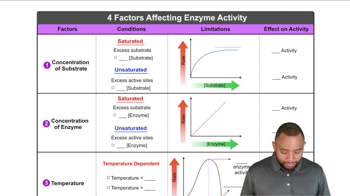
pH is a measure of the acidity or alkalinity of a solution, which can significantly impact enzyme activity. Each enzyme has an optimal pH range where it functions best; deviations from this range can lead to decreased activity or denaturation. For instance, pepsin is adapted to function in the highly acidic environment of the stomach (pH 1.5), while chymotrypsin operates optimally in a more neutral pH, typically around 7.5, affecting their catalytic activities in different environments.
Video consigliato:
Percorso guidato
5:33
Factors Affecting Enzyme Activity Concept 2

Specificity of Enzymes

Enzymes exhibit specificity, meaning they are designed to catalyze specific reactions or act on particular substrates. This specificity is determined by the enzyme's active site structure, which complements the substrate's shape and chemical properties. Pepsin and chymotrypsin, while both proteolytic enzymes, have evolved to function optimally in different environments and with different substrates, which explains their varying activities at pH 1.5.
Video consigliato:
Percorso guidato
01:37
Specific Gravity
Pratica correlata