
Ch.6 Carbohydrates Life's Sweet Molecules
Frost - General, Organic and Biological Chemistry 4th Edition
Frost4th EditionGeneral, Organic and Biological ChemistryISBN: 9780134988696Non è quello che usi tu?Cambia libro di testo
Capitolo 3, Problema 90

Which of the components in starch is more likely to be broken down more quickly in plants, amylose or amylopectin? Why?

Guida verificata passo dopo passo
1
Understand the structure of starch: Starch is a polysaccharide made up of two components, amylose and amylopectin. Amylose is a linear polymer of glucose, while amylopectin is a branched polymer of glucose.
Recognize the difference in structure: Amylose has a straight-chain structure, which makes it more compact and less accessible to enzymes. Amylopectin, on the other hand, has a highly branched structure, which provides more surface area for enzymatic action.
Consider enzymatic breakdown: Enzymes like amylase break down starch by hydrolyzing the glycosidic bonds between glucose units. The branched structure of amylopectin allows enzymes to access multiple points simultaneously, making it easier and faster to break down.
Relate to the rate of breakdown: Because amylopectin has more branching and is more accessible to enzymes, it is broken down more quickly compared to amylose, which has a more compact and linear structure.
Conclude the reasoning: Amylopectin is more likely to be broken down more quickly in plants due to its branched structure, which increases enzymatic accessibility and speeds up the hydrolysis process.

Risposta video verificata per un problema simile:

Questa soluzione video è stata consigliata dai nostri tutor come utile per risolvere questo problema.
Durata del video:
2m

Concetti chiave

Ecco i concetti essenziali che devi comprendere per rispondere correttamente alla domanda.

Starch Structure

Starch is a polysaccharide composed of two main components: amylose and amylopectin. Amylose is a linear chain of glucose units, while amylopectin is a branched structure. The structural differences between these two components influence their digestibility and breakdown rates in plants.
Video consigliato:
Percorso guidato
1:01
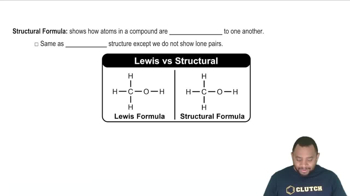
Structural Formula Concept 2

Enzymatic Breakdown

The breakdown of starch in plants is facilitated by enzymes such as amylase. These enzymes target the glycosidic bonds in starch, with amylopectin being more accessible due to its branched structure. This accessibility allows amylopectin to be broken down more quickly than amylose, which requires more time for enzymatic action.
Video consigliato:
Percorso guidato
3:09
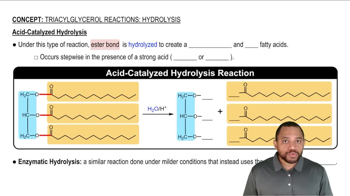
Triacylglycerol Reactions: Hydrolysis Concept 1

Plant Metabolism

In plants, starch serves as a crucial energy reserve. The rate at which starch components are broken down can affect overall plant metabolism and energy availability. Understanding the differences in breakdown rates between amylose and amylopectin is essential for comprehending how plants utilize stored energy during growth and development.
Video consigliato:
Percorso guidato
0:52
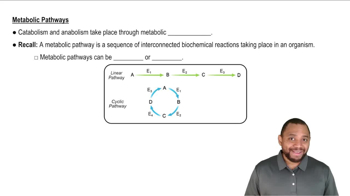
Metabolic Pathways Concept 2
Pratica correlata
Domanda del libro di testo

The structure of sucralose, found in the artificial sweetener Splenda, is shown in the figure. It consists of a chlorinated disaccharide made up of galactose and fructose. In its structure shown, (b) identify the type of glycosidic bond present.

56
views
Domanda del libro di testo

Carbohydrates are abbreviated using a three-letter abbreviation followed by their glycosidic bond type. For example, maltose and sucrose can be written respectively as

Provide the structure for the O-type blood carbohydrate set given the following abbreviation:

L-Fucα (1→2) Galß(1→4)GlcNAc

705
views
Domanda del libro di testo

D-Fructose can also form a six-membered ring. Draw the β anomer of D-fructose in the six-membered ring form.

512
views
Domanda del libro di testo

The structure of sucralose, found in the artificial sweetener Splenda, is shown in the figure. It consists of a chlorinated disaccharide made up of galactose and fructose. In its structure shown,

(a) identify the galactose unit and the fructose unit.

1290
views
Domanda del libro di testo

How much energy is produced if a person eats 50 g of digestible carbohydrate (not fiber) in a day? In this case, what percent of a 2200 Calorie diet would be digestible carbohydrate? Recall that carbohydrates provide four Calories of energy per gram consumed.

762
views
Domanda del libro di testo

Trehalose is a naturally occurring disaccharide used in cosmetics because of its ability to retain moisture. The formal name of trehalose is glucose α, α(1→1) glucose. Draw the structure of trehalose. Is it a reducing or nonreducing sugar?

625
views