

Ch.6 Carbohydrates Life's Sweet Molecules
Frost - General, Organic and Biological Chemistry 4th Edition
Frost4th EditionGeneral, Organic and Biological ChemistryISBN: 9780134988696Non è quello che usi tu?Cambia libro di testo
Capitolo 3, Problema 88

Carbohydrates are abbreviated using a three-letter abbreviation followed by their glycosidic bond type. For example, maltose and sucrose can be written respectively as

Provide the structure for the O-type blood carbohydrate set given the following abbreviation:
L-Fucα (1→2) Galß(1→4)GlcNAc

Guida verificata passo dopo passo
1
Step 1: Understand the abbreviation provided for the carbohydrate structure. The abbreviation L-Fucα (1→2) Galß (1→4) GlcNAc represents a carbohydrate chain where L-Fucose (L-Fuc) is linked to Galactose (Gal) via an alpha (α) glycosidic bond at position 1→2, and Galactose is linked to N-Acetylglucosamine (GlcNAc) via a beta (ß) glycosidic bond at position 1→4.
Step 2: Begin by drawing the structure of the first monosaccharide, L-Fucose (L-Fuc). L-Fucose is a six-carbon sugar with a methyl group (-CH3) attached to the carbon at position 6. Ensure the glycosidic bond at position 1 is oriented in the alpha (α) configuration.
Step 3: Next, draw the structure of the second monosaccharide, Galactose (Gal). Galactose is also a six-carbon sugar. Connect the anomeric carbon (carbon 1) of L-Fucose to the carbon at position 2 of Galactose via the alpha (α) glycosidic bond.
Step 4: Draw the structure of the third monosaccharide, N-Acetylglucosamine (GlcNAc). GlcNAc is a derivative of glucose with an acetyl group (-COCH3) attached to the nitrogen on carbon 2. Connect the anomeric carbon (carbon 1) of Galactose to the carbon at position 4 of GlcNAc via the beta (ß) glycosidic bond.
Step 5: Verify the orientation and connectivity of all glycosidic bonds (α for L-Fuc to Gal and ß for Gal to GlcNAc) and ensure the stereochemistry of each monosaccharide is correct. Label each sugar and glycosidic bond type clearly in your diagram.

Risposta video verificata per un problema simile:

Questa soluzione video è stata consigliata dai nostri tutor come utile per risolvere questo problema.
Durata del video:
9m

Concetti chiave

Ecco i concetti essenziali che devi comprendere per rispondere correttamente alla domanda.

Glycosidic Bonds

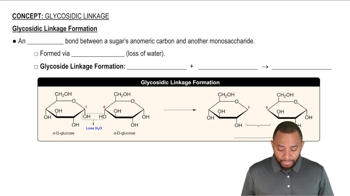
Glycosidic bonds are covalent linkages formed between carbohydrates, specifically between the anomeric carbon of one sugar and a hydroxyl group of another. The type of glycosidic bond, indicated by the configuration (α or ß) and the position (e.g., 1→2, 1→4), determines the structural and functional properties of the carbohydrate. Understanding these bonds is crucial for interpreting carbohydrate structures and their biological roles.
Video consigliato:
Percorso guidato
1:44
Glycosidic Linkage Formation Concept 1

Carbohydrate Abbreviations

Carbohydrates are often represented using three-letter abbreviations that denote the specific sugar and its configuration. For example, 'Glc' stands for glucose, 'Gal' for galactose, and 'Fru' for fructose. These abbreviations simplify the representation of complex carbohydrate structures, making it easier to communicate and analyze their compositions and linkages in biochemical contexts.
Video consigliato:
Percorso guidato
1:29
Classification of Carbohydrates Example 1

Blood Group Carbohydrates

Blood group carbohydrates are specific oligosaccharides found on the surface of red blood cells that determine an individual's blood type. The O-type blood group is characterized by the presence of specific carbohydrate structures, including fucose, galactose, and N-acetylglucosamine, linked in a particular arrangement. Understanding these structures is essential for studying blood compatibility and transfusion medicine.
Video consigliato:
Percorso guidato
1:48
Intro to Carbohydrates Concept 1
Pratica correlata
Domanda del libro di testo

The structure of sucralose, found in the artificial sweetener Splenda, is shown in the figure. It consists of a chlorinated disaccharide made up of galactose and fructose. In its structure shown, (b) identify the type of glycosidic bond present.

56
views
Domanda del libro di testo

The structure of sucralose, found in the artificial sweetener Splenda, is shown in the figure. It consists of a chlorinated disaccharide made up of galactose and fructose. In its structure shown,

(a) identify the galactose unit and the fructose unit.

1290
views
Domanda del libro di testo

Which of the components in starch is more likely to be broken down more quickly in plants, amylose or amylopectin? Why?

713
views
Domanda del libro di testo

Glycogen and amylopectin are both branched polymers of glucose. Read the descriptions of each in Section 6.6. Which molecule has a more compact structure? Explain.

1077
views
Domanda del libro di testo

On an exam, a student was asked to draw the Fischer projection of L-glucose, but he had only memorized the structure of D-glucose. He wrote the structure of D-glucose and switched the hydroxyl group on C5 from the right to the left. Was his answer correct? If not, what is the name of the aldose that he drew?

660
views
Domanda del libro di testo

The shell of a shrimp is composed of chitin. If you eat a boiled shrimp without removing the shell, will your body break the shell down into its component sugars? Explain. (Hint: Compare chitin’s structure to that of amylose and cellulose.)

881
views