Ch.6 Carbohydrates Life's Sweet Molecules
Frost - General, Organic and Biological Chemistry 4th Edition
Frost4th EditionGeneral, Organic and Biological ChemistryISBN: 9780134988696Non è quello che usi tu?Cambia libro di testo
Capitolo 3, Problema 89b

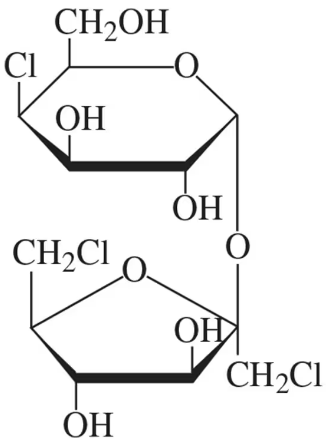
The structure of sucralose, found in the artificial sweetener Splenda, is shown in the figure. It consists of a chlorinated disaccharide made up of galactose and fructose. In its structure shown, (b) identify the type of glycosidic bond present.
Structure of sucralose, a chlorinated disaccharide of galactose and fructose, highlighting its glycosidic bond.

Guida verificata passo dopo passo
1
Examine the structure of sucralose provided in the image. It consists of two monosaccharides: galactose and fructose, connected by a glycosidic bond.
Identify the glycosidic bond in the structure. A glycosidic bond is formed between the anomeric carbon of one sugar and a hydroxyl group of another sugar.
In the structure, observe that the bond connects the anomeric carbon of the galactose unit (top monosaccharide) to the oxygen atom of the fructose unit (bottom monosaccharide).
Determine the type of glycosidic bond based on the orientation and position of the linkage. The bond appears to be an α-1,4 glycosidic bond, as the oxygen bridge connects the 1st carbon of galactose to the 4th carbon of fructose.
Conclude that the glycosidic bond in sucralose is an α-1,4 glycosidic bond, which is typical for disaccharides like maltose but modified here due to the chlorination in sucralose.

Risposta video verificata per un problema simile:

Questa soluzione video è stata consigliata dai nostri tutor come utile per risolvere questo problema.
Durata del video:
4m

Concetti chiave

Ecco i concetti essenziali che devi comprendere per rispondere correttamente alla domanda.

Glycosidic Bond

A glycosidic bond is a type of covalent bond that connects a carbohydrate (sugar) molecule to another group, which can also be a carbohydrate. In disaccharides like sucralose, this bond forms between the anomeric carbon of one sugar and a hydroxyl group of another, resulting in a linkage that is crucial for the structure and function of the molecule.
Video consigliato:
Percorso guidato
1:44
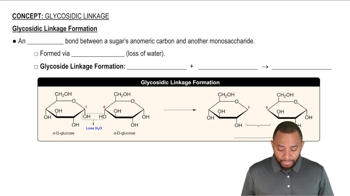
Glycosidic Linkage Formation Concept 1

Disaccharide Structure

Disaccharides are carbohydrates composed of two monosaccharide units linked by a glycosidic bond. In the case of sucralose, the disaccharide is formed from galactose and fructose. Understanding the arrangement and types of these monosaccharides is essential for analyzing the properties and sweetness of the artificial sweetener.
Video consigliato:
Percorso guidato
3:39
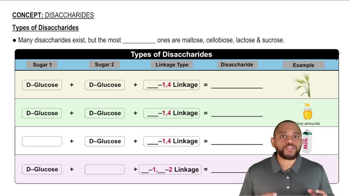
Types of Disaccharides Concept 1

Chlorination in Sugars

Chlorination refers to the introduction of chlorine atoms into a molecule, which can significantly alter its chemical properties. In sucralose, chlorination enhances sweetness and stability compared to regular sugars. Recognizing how chlorination affects the structure and function of carbohydrates is important for understanding the unique characteristics of artificial sweeteners.
Video consigliato:
Percorso guidato
1:01
Ketoses as Reducing Sugars Example 2
Pratica correlata
Domanda del libro di testo

Carbohydrates are abbreviated using a three-letter abbreviation followed by their glycosidic bond type. For example, maltose and sucrose can be written respectively as

Provide the structure for the O-type blood carbohydrate set given the following abbreviation:

L-Fucα (1→2) Galß(1→4)GlcNAc

705
views
Domanda del libro di testo

D-Fructose can also form a six-membered ring. Draw the β anomer of D-fructose in the six-membered ring form.

512
views
Domanda del libro di testo

The structure of sucralose, found in the artificial sweetener Splenda, is shown in the figure. It consists of a chlorinated disaccharide made up of galactose and fructose. In its structure shown,

(a) identify the galactose unit and the fructose unit.

1290
views
Domanda del libro di testo

How much energy is produced if a person eats 50 g of digestible carbohydrate (not fiber) in a day? In this case, what percent of a 2200 Calorie diet would be digestible carbohydrate? Recall that carbohydrates provide four Calories of energy per gram consumed.

762
views
Domanda del libro di testo

Which of the components in starch is more likely to be broken down more quickly in plants, amylose or amylopectin? Why?

713
views
Domanda del libro di testo

On an exam, a student was asked to draw the Fischer projection of L-glucose, but he had only memorized the structure of D-glucose. He wrote the structure of D-glucose and switched the hydroxyl group on C5 from the right to the left. Was his answer correct? If not, what is the name of the aldose that he drew?

660
views