Glucose, a form of sugar, has the formula C6H12O6. Which elements are included in this compound, and how many atoms of each are present?
Ch.1 Matter and Measurements
McMurry8th EditionFundamentals of General, Organic, and Biological ChemistryISBN: 9780134015187Non è quello che usi tu?Cambia libro di testo
Capitolo 1, Problema 40
Butane (C4H8) is an easily compressible gas used in cigarette lighters. It has a melting point of and a boiling point of -138.4 °C and a boiling point of -0.5 °C. Would you expect a butane lighter to work in winter when the temperature outdoors is 25 °F? Why or why not?
Guida verificata passo dopo passo1
Step 1: Convert the outdoor temperature from Fahrenheit to Celsius using the formula: . Plug in 25°F to calculate the equivalent temperature in Celsius.
Step 2: Compare the converted temperature to the boiling point of butane, which is 0.5°C. Recall that butane must be in the gaseous state to function in a lighter, and this occurs when the temperature is above its boiling point.
Step 3: If the outdoor temperature is below the boiling point of butane, it will remain in the liquid state and may not vaporize effectively to produce a flame. If the temperature is above the boiling point, butane will vaporize and the lighter should work.
Step 4: Consider the physical properties of butane and how temperature affects its phase. At temperatures below the boiling point, the kinetic energy of butane molecules is insufficient to overcome intermolecular forces, keeping it in the liquid phase.
Step 5: Based on the comparison, determine whether the outdoor temperature allows butane to vaporize and explain why this affects the functionality of the lighter in winter conditions.

Risposta video verificata per un problema simile:
Questa soluzione video è stata consigliata dai nostri tutor come utile per risolvere questo problema.
Durata del video:
3mConcetti chiave
Ecco i concetti essenziali che devi comprendere per rispondere correttamente alla domanda.
Phase Changes
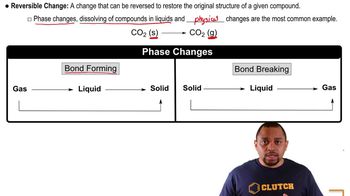
Phase changes refer to the transitions between solid, liquid, and gas states of matter, which are influenced by temperature and pressure. For butane, its melting point (-138.4°C) indicates that it remains a gas at typical outdoor temperatures, while its boiling point (0.5°C) shows that it can condense into a liquid at lower temperatures. Understanding these phase changes is crucial for predicting the behavior of butane in different environmental conditions.
Video consigliato:
Percorso guidato
Physical & Chemical Changes
Temperature and Gas Behavior
The behavior of gases is significantly affected by temperature, as described by gas laws. At lower temperatures, gases can condense into liquids, which is relevant for butane in winter conditions. When the outdoor temperature is 25°F (-3.9°C), which is below butane's boiling point, the gas may not vaporize effectively, impacting the lighter's functionality.
Video consigliato:
Percorso guidato
The Ideal Gas Law Concept 1
Pressure and Compression
Compression refers to the reduction of gas volume under pressure, which can affect its state and usability. Butane is easily compressible, allowing it to be stored as a liquid in lighters. However, if the temperature is too low, the pressure may not be sufficient to keep butane in a gaseous state, leading to difficulties in igniting the lighter in cold weather.
Video consigliato:
Percorso guidato
Pressure Units Concept 1
Pratica correlata
Domanda del libro di testo
3709
views
Domanda del libro di testo
Hydrogen peroxide, often used in solutions to cleanse cuts and scrapes, breaks down to yield water and oxygen: Hydrogen peroxide, H2O2(aq) → Hydrogen, H2(g) + Oxygen, O2(g)
b. Which of the substances are chemical compounds, and which are elements?
2541
views
Domanda del libro di testo
Name two changes of state and describe what causes each to occur.
1840
views
Domanda del libro di testo
Which of these terms, (i) mixture, (ii) solid, (iii) liquid, (iv) gas, (v) chemical element, (vi) chemical compound, applies to the following substances at room temperature?
a. Gasoline
b. Iodine
c. Water
d. Air
e. Blood
f. Sodium bicarbonate
g. Gaseous ammonia
h. Silicon
2056
views
Domanda del libro di testo
What is the difference between a physical change and a chemical change?
3049
views
Domanda del libro di testo
Name and describe the three states of matter.
3211
views