
Ch.11 Nuclear Chemistry
McMurry - Fundamentals of General, Organic, and Biological Chemistry 8th Edition
McMurry8th EditionFundamentals of General, Organic, and Biological ChemistryISBN: 9780134015187Non è quello che usi tu?Cambia libro di testo
Capitolo 11, Problema 12

A β-emitting radiation source gives 250 units of radiation at a distance of 4.0 m. At what distance does the radiation drop to one-tenth its original value?

Guida verificata passo dopo passo
1
Understand the problem: The intensity of radiation follows the inverse square law, which states that the intensity of radiation is inversely proportional to the square of the distance from the source. Mathematically, this can be expressed as \( I \propto \frac{1}{d^2} \), where \( I \) is the intensity and \( d \) is the distance.
Set up the relationship: Let the initial intensity \( I_1 \) be 250 units at a distance \( d_1 = 4.0 \, \text{m} \). The final intensity \( I_2 \) is one-tenth of the original intensity, so \( I_2 = \(\frac{I_1}{10}\) = 25 \, \(\text{units}\).
Use the inverse square law formula: \( \frac{I_1}{I_2} = \left( \frac{d_2}{d_1} \right)^2 \). Substitute \( I_1 = 250 \), \( I_2 = 25 \), and \( d_1 = 4.0 \, \text{m} \) into the equation.
Solve for \( d_2 \): Rearrange the formula to isolate \( d_2 \): \( d_2 = d_1 \sqrt{\frac{I_1}{I_2}} \). Substitute the known values into the equation.
Perform the calculation: Calculate \( d_2 \) using the values substituted in the previous step to determine the distance at which the radiation drops to one-tenth its original value.

Risposta video verificata per un problema simile:

Questa soluzione video è stata consigliata dai nostri tutor come utile per risolvere questo problema.
Durata del video:
2m

Concetti chiave

Ecco i concetti essenziali che devi comprendere per rispondere correttamente alla domanda.

Inverse Square Law

The Inverse Square Law states that the intensity of radiation from a point source decreases with the square of the distance from the source. This means that if you double the distance from the source, the intensity of radiation is reduced to one-fourth. This principle is crucial for understanding how radiation levels change with distance.
Video consigliato:
Percorso guidato
04:24
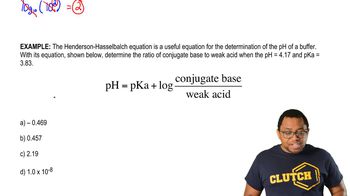
Inverse Logarithmic Functions

Radioactive Decay

Radioactive decay refers to the process by which unstable atomic nuclei lose energy by emitting radiation. The rate of decay is characterized by the half-life, which is the time required for half of the radioactive atoms in a sample to decay. Understanding this concept helps in determining how radiation levels decrease over distance and time.
Video consigliato:
Percorso guidato
02:52
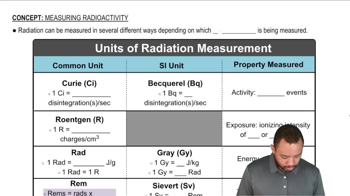
Measuring Radioactivity Concept 1

Radiation Dose Measurement

Radiation dose measurement quantifies the amount of radiation energy absorbed by an object or person. It is often expressed in units such as grays (Gy) or sieverts (Sv). Knowing how to measure and interpret radiation doses is essential for assessing exposure levels and understanding the implications of radiation on health and safety.
Video consigliato:
Percorso guidato
02:52
Measuring Radioactivity Concept 1