Ch.11 Nuclear Chemistry
McMurry - Fundamentals of General, Organic, and Biological Chemistry 8th Edition
McMurry8th EditionFundamentals of General, Organic, and Biological ChemistryISBN: 9780134015187Non è quello che usi tu?Cambia libro di testo
Capitolo 11, Problema 69

If a radiation source has an intensity of 650 rem at 1.0 m, what distance is needed to decrease the intensity of exposure to below 25 rem, the level at which no effects are detectable?

Guida verificata passo dopo passo
1
Understand that the intensity of radiation follows the inverse square law, which states that intensity is inversely proportional to the square of the distance from the source. Mathematically, this is expressed as: I_1/I_2 = (d_2/d_1)^2, where I_1 and I_2 are the intensities at distances d_1 and d_2, respectively.
Identify the given values: I_1 = 650 \, \(\text{rem}\), d_1 = 1.0 \, \(\text{m}\), and I_2 = 25 \, \(\text{rem}\). The goal is to solve for d_2, the distance at which the intensity is reduced to below 25 rem.
Rearrange the inverse square law formula to solve for d_2: d_2 = d_1 \(\sqrt{I_1/I_2}\).
Substitute the known values into the formula: d_2 = 1.0 \, \(\text{m}\) \(\sqrt{650 \, \text{rem}\) / 25 \, \(\text{rem}\)}. Simplify the ratio inside the square root.
Calculate the square root and multiply by d_1 to find d_2. This will give the distance at which the intensity is reduced to below 25 rem.

Risposta video verificata per un problema simile:

Questa soluzione video è stata consigliata dai nostri tutor come utile per risolvere questo problema.
Durata del video:
2m

Concetti chiave

Ecco i concetti essenziali che devi comprendere per rispondere correttamente alla domanda.

Inverse Square Law

The Inverse Square Law states that the intensity of radiation decreases with the square of the distance from the source. This means that if you double the distance from the radiation source, the intensity of exposure is reduced to one-fourth. Understanding this principle is crucial for calculating how far one must be from a radiation source to achieve a desired intensity level.
Video consigliato:
Percorso guidato
04:24
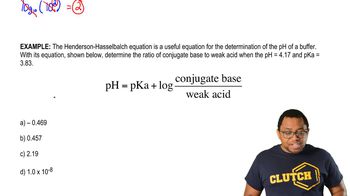
Inverse Logarithmic Functions

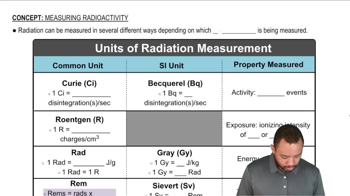
Radiation Exposure Measurement

Radiation exposure is often measured in rems, which quantify the biological effect of ionizing radiation on human tissue. A level of 25 rem is considered the threshold below which no detectable effects occur. Familiarity with these units and their implications helps in assessing safety levels in radiation exposure scenarios.
Video consigliato:
Percorso guidato
02:52
Measuring Radioactivity Concept 1

Logarithmic Scale of Intensity

Radiation intensity often follows a logarithmic scale, meaning that small changes in distance can lead to significant changes in exposure levels. This concept is important when calculating the distance required to reduce exposure from a high level to a much lower one, as it emphasizes the non-linear relationship between distance and intensity.
Video consigliato:
Percorso guidato
02:45
Intensive vs. Extensive Properties