Ch.3 Ionic Compounds
McMurry - Fundamentals of General, Organic, and Biological Chemistry 8th Edition
McMurry8th EditionFundamentals of General, Organic, and Biological ChemistryISBN: 9780134015187Non è quello che usi tu?Cambia libro di testo
Capitolo 3, Problema 57a

Write equations for the loss of an electron by a K atom and the gain of an electron by a K+ ion.

Guida verificata passo dopo passo
1
Step 1: Understand the problem. The problem involves writing two equations: one for the loss of an electron by a potassium (K) atom and another for the gain of an electron by a potassium ion (K⁺). These are oxidation and reduction processes, respectively.
Step 2: Write the equation for the loss of an electron by a K atom. When a neutral potassium atom loses one electron, it becomes a positively charged potassium ion (K⁺). The equation can be written as: K ightarrow K^+ + e^-.
Step 3: Write the equation for the gain of an electron by a K⁺ ion. When a positively charged potassium ion (K⁺) gains one electron, it becomes a neutral potassium atom. The equation can be written as: K^+ + e^- ightarrow K.
Step 4: Verify the equations. Ensure that the charges and the number of particles are balanced on both sides of each equation. For the first equation, the charge changes from 0 to +1, and for the second equation, the charge changes from +1 to 0, which is consistent with the processes described.
Step 5: Review the concepts. The loss of an electron is called oxidation, and the gain of an electron is called reduction. These processes are part of redox reactions, which involve the transfer of electrons between species.

Risposta video verificata per un problema simile:

Questa soluzione video è stata consigliata dai nostri tutor come utile per risolvere questo problema.
Durata del video:
2m

Concetti chiave

Ecco i concetti essenziali che devi comprendere per rispondere correttamente alla domanda.

Ionization Energy

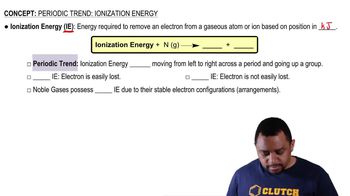
Ionization energy is the energy required to remove an electron from an atom or ion in its gaseous state. For a potassium (K) atom, this process involves overcoming the attractive force between the negatively charged electron and the positively charged nucleus. The equation for this process can be represented as K(g) → K⁺(g) + e⁻, indicating that an electron is lost, resulting in a positively charged ion.
Video consigliato:
Percorso guidato
02:13
Periodic Trend: Ionization Energy (Simplified) Concept 1

Electron Affinity

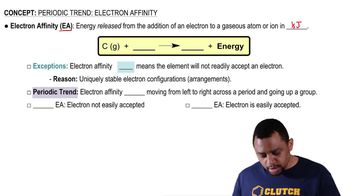
Electron affinity refers to the energy change that occurs when an electron is added to a neutral atom in the gaseous state. For a potassium ion (K⁺), gaining an electron results in the formation of a neutral potassium atom. This process can be represented by the equation K⁺(g) + e⁻ → K(g), where energy is typically released, indicating that the ion is more stable after gaining an electron.
Video consigliato:
Percorso guidato
01:56
Periodic Trend: Electron Affinity (Simplified) Concept 1

Charge Conservation

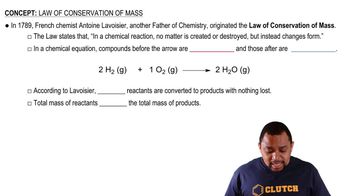
Charge conservation is a fundamental principle in chemistry and physics stating that the total electric charge in an isolated system remains constant. In the context of the given question, when a K atom loses an electron, it becomes positively charged (K⁺), while the electron itself carries a negative charge. Similarly, when K⁺ gains an electron, the overall charge is balanced, maintaining the conservation of charge throughout the processes.
Video consigliato:
Percorso guidato
01:48
Law of Conservation of Mass