Ch.5 Classification & Balancing of Chemical Reactions
McMurry - Fundamentals of General, Organic, and Biological Chemistry 8th Edition
McMurry8th EditionFundamentals of General, Organic, and Biological ChemistryISBN: 9780134015187Non è quello che usi tu?Cambia libro di testo
Capitolo 5, Problema 49

In each of the following, tell whether the substance gains electrons or loses electrons in a redox reaction:
a. An oxidizing agent
b. A reducing agent
c. A substance undergoing oxidation
d. A substance undergoing reduction

Guida verificata passo dopo passo
1
Understand the key concepts: In a redox reaction, oxidation involves the loss of electrons, while reduction involves the gain of electrons. An oxidizing agent is the substance that causes oxidation by gaining electrons, and a reducing agent is the substance that causes reduction by losing electrons.
For part (a): An oxidizing agent gains electrons because it is reduced in the process of oxidizing another substance.
For part (b): A reducing agent loses electrons because it is oxidized in the process of reducing another substance.
For part (c): A substance undergoing oxidation loses electrons, as oxidation is defined as the loss of electrons.
For part (d): A substance undergoing reduction gains electrons, as reduction is defined as the gain of electrons.

Risposta video verificata per un problema simile:

Questa soluzione video è stata consigliata dai nostri tutor come utile per risolvere questo problema.
Durata del video:
1m

Concetti chiave

Ecco i concetti essenziali che devi comprendere per rispondere correttamente alla domanda.

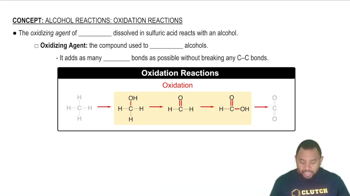
Oxidizing Agent

An oxidizing agent is a substance that gains electrons in a redox reaction, causing another substance to be oxidized. By accepting electrons, it undergoes reduction itself. This process is crucial in various chemical reactions, including combustion and respiration, where the oxidizing agent facilitates the transfer of electrons.
Video consigliato:
Percorso guidato
1:49
Alcohol Reactions: Oxidation Concept 1

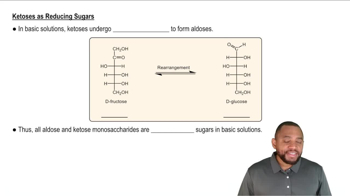
Reducing Agent

A reducing agent is a substance that loses electrons in a redox reaction, thereby causing another substance to be reduced. By donating electrons, it undergoes oxidation. Reducing agents are essential in many chemical processes, such as metal extraction and organic synthesis, where they help convert compounds to their reduced forms.
Video consigliato:
Percorso guidato
1:03
Ketoses as Reducing Sugars Concept 2

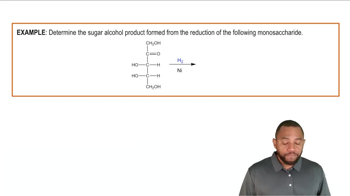
Oxidation and Reduction

Oxidation refers to the process where a substance loses electrons, resulting in an increase in oxidation state. Conversely, reduction is the gain of electrons, leading to a decrease in oxidation state. These two processes are interconnected in redox reactions, where one substance is oxidized while another is reduced, highlighting the conservation of charge.
Video consigliato:
Percorso guidato
0:55
Reduction of Monosaccharides Example 1
Pratica correlata
Domanda del libro di testo

Which of the following equations are balanced? Balance those that need it.

a. CaC2 + 2 H2O → Ca(OH)2 +C2H2

b. C2H8N2 + 2 N2O4 → 2 N2 + 2 CO2 + 4 H2O

c. 3 MgO + 2 Fe → Fe2O3 + 3 Mg

d. N2O → N2 + O2

2374
views

Domanda del libro di testo

When sodium metal is placed in water, the following change occurs: Sodium, Na(s) + Water, H2O(l) → Hydrogen, H2(g) + Sodium hydroxide, NaOH(aq)

a. Identify the reactants and products and their physical states

2817
views
Domanda del libro di testo

Many pharmaceuticals are marketed with the designation "HCl" appended to the name of the drug. What does the "HCl" mean? What type of reaction would be involved in converting a drug to the HCl form? What are the advantages of this form of the drug?

2529
views
Domanda del libro di testo

Why is it not possible to balance an equation by changing the subscript on a substance, say from H2O to H2O2?

2804
views
Domanda del libro di testo

High temperature combustion processes, such as in combustion engines and coal-fired power plants, can result in the reaction of nitrogen and sulfur with oxygen to form nitrogen oxides (NO𝓍) and sulfur oxides (SO𝓍), where x can vary. These NO𝓍 and SO𝓍 compounds subsequently undergo further reaction in the atmosphere to create acidic compounds that contribute to acid rain.

a. Do some research to determine the common products that are formed (i.e., what are the values of x) for the reactions of N and S with oxygen. Write balanced equations for these reactions.

2036
views