Ch.5 Classification & Balancing of Chemical Reactions
McMurry - Fundamentals of General, Organic, and Biological Chemistry 8th Edition
McMurry8th EditionFundamentals of General, Organic, and Biological ChemistryISBN: 9780134015187Non è quello che usi tu?Cambia libro di testo
Capitolo 5, Problema 44a

When sodium metal is placed in water, the following change occurs: Sodium, Na(s) + Water, H2O(l) → Hydrogen, H2(g) + Sodium hydroxide, NaOH(aq)
a. Identify the reactants and products and their physical states

Guida verificata passo dopo passo
1
Step 1: Identify the reactants in the given chemical equation. Reactants are the substances present on the left side of the arrow. In this case, the reactants are sodium (Na) and water (H₂O).
Step 2: Identify the physical states of the reactants. Sodium (Na) is a solid, denoted as (s), and water (H₂O) is a liquid, denoted as (l).
Step 3: Identify the products in the given chemical equation. Products are the substances present on the right side of the arrow. In this case, the products are hydrogen gas (H₂) and sodium hydroxide (NaOH).
Step 4: Identify the physical states of the products. Hydrogen (H₂) is a gas, denoted as (g), and sodium hydroxide (NaOH) is an aqueous solution, denoted as (aq).
Step 5: Summarize the reactants and products with their physical states: Reactants: Sodium (Na (s)) and Water (H₂O (l)); Products: Hydrogen (H₂ (g)) and Sodium hydroxide (NaOH (aq)).

Risposta video verificata per un problema simile:

Questa soluzione video è stata consigliata dai nostri tutor come utile per risolvere questo problema.
Durata del video:
2m

Concetti chiave

Ecco i concetti essenziali che devi comprendere per rispondere correttamente alla domanda.

Reactants and Products

In a chemical reaction, reactants are the starting substances that undergo a change, while products are the substances formed as a result of the reaction. In the given equation, sodium (Na) and water (H2O) are the reactants, and hydrogen gas (H2) and sodium hydroxide (NaOH) are the products.
Video consigliato:
Percorso guidato
01:37
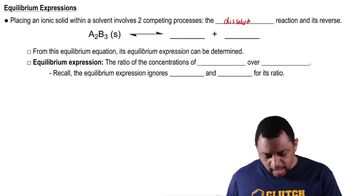
Solubility Product Constant (Ksp) Concept 2

Physical States

The physical state of a substance indicates its form at a given temperature and pressure, typically categorized as solid (s), liquid (l), gas (g), or aqueous (aq). In the reaction, sodium is a solid (s), water is a liquid (l), hydrogen is a gas (g), and sodium hydroxide is in an aqueous solution (aq).
Video consigliato:
Percorso guidato
01:01
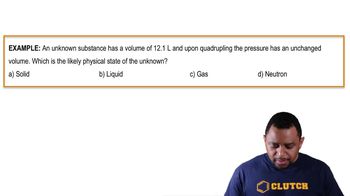
States of Matter Example 1

Chemical Equation

A chemical equation is a symbolic representation of a chemical reaction, showing the reactants on the left and the products on the right, separated by an arrow. It conveys the conservation of mass, indicating that the number of atoms of each element is the same before and after the reaction, which is essential for balancing the equation.
Video consigliato:
Percorso guidato
01:32
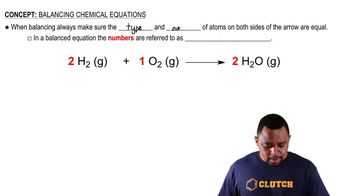
Balancing Chemical Equations (Simplified) Concept 1
Pratica correlata
Domanda del libro di testo

Which of the following equations are balanced? Balance those that need it.

a. CaC2 + 2 H2O → Ca(OH)2 +C2H2

b. C2H8N2 + 2 N2O4 → 2 N2 + 2 CO2 + 4 H2O

c. 3 MgO + 2 Fe → Fe2O3 + 3 Mg

d. N2O → N2 + O2

2366
views

Domanda del libro di testo

Many pharmaceuticals are marketed with the designation "HCl" appended to the name of the drug. What does the "HCl" mean? What type of reaction would be involved in converting a drug to the HCl form? What are the advantages of this form of the drug?

2492
views
Domanda del libro di testo

Why is it not possible to balance an equation by changing the subscript on a substance, say from H2O to H2O2?

2792
views
Domanda del libro di testo

What is meant by the term 'balanced equation'?

3037
views
Domanda del libro di testo

In each of the following, tell whether the substance gains electrons or loses electrons in a redox reaction:

a. An oxidizing agent

b. A reducing agent

c. A substance undergoing oxidation

d. A substance undergoing reduction

1840
views
Domanda del libro di testo

High temperature combustion processes, such as in combustion engines and coal-fired power plants, can result in the reaction of nitrogen and sulfur with oxygen to form nitrogen oxides (NO𝓍) and sulfur oxides (SO𝓍), where x can vary. These NO𝓍 and SO𝓍 compounds subsequently undergo further reaction in the atmosphere to create acidic compounds that contribute to acid rain.

a. Do some research to determine the common products that are formed (i.e., what are the values of x) for the reactions of N and S with oxygen. Write balanced equations for these reactions.

2030
views