
Ch.5 Classification & Balancing of Chemical Reactions
McMurry - Fundamentals of General, Organic, and Biological Chemistry 8th Edition
McMurry8th EditionFundamentals of General, Organic, and Biological ChemistryISBN: 9780134015187Non è quello che usi tu?Cambia libro di testo
Capitolo 5, Problema 22

What is meant by the term 'balanced equation'?

Guida verificata passo dopo passo
1
A balanced equation is a chemical equation where the number of atoms of each element is the same on both the reactant and product sides of the equation, ensuring the law of conservation of mass is satisfied.
To balance an equation, start by writing the unbalanced chemical equation, which shows the reactants and products with their respective chemical formulas.
Identify the number of atoms of each element on both sides of the equation. Use coefficients (whole numbers placed in front of the chemical formulas) to adjust the number of atoms as needed.
Balance one element at a time, starting with the most complex molecule or the element that appears in only one reactant and one product. Adjust coefficients systematically to equalize the atom counts.
Double-check the final equation to ensure all elements are balanced and that the coefficients are in the simplest whole-number ratio. Verify that the total mass of reactants equals the total mass of products.

Risposta video verificata per un problema simile:

Questa soluzione video è stata consigliata dai nostri tutor come utile per risolvere questo problema.
Durata del video:
3m

Concetti chiave

Ecco i concetti essenziali che devi comprendere per rispondere correttamente alla domanda.

Chemical Equation

A chemical equation is a symbolic representation of a chemical reaction, showing the reactants on the left side and the products on the right. It uses chemical formulas to depict the substances involved and their respective quantities. Understanding chemical equations is fundamental to grasping how substances interact and transform during reactions.
Video consigliato:
Percorso guidato
01:32
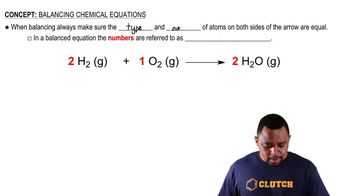
Balancing Chemical Equations (Simplified) Concept 1

Law of Conservation of Mass

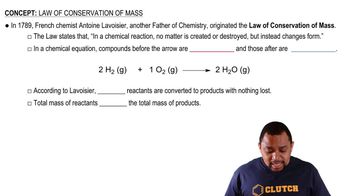
The Law of Conservation of Mass states that mass is neither created nor destroyed in a chemical reaction. This principle is crucial for balancing equations, as it requires that the total mass of reactants equals the total mass of products. This law ensures that the number of atoms for each element remains constant throughout the reaction.
Video consigliato:
Percorso guidato
01:48
Law of Conservation of Mass

Balancing Chemical Equations

Balancing chemical equations involves adjusting the coefficients of the reactants and products to ensure that the number of atoms of each element is the same on both sides of the equation. This process is essential for accurately representing the reaction and adhering to the Law of Conservation of Mass. A balanced equation provides a clear and precise description of the chemical reaction taking place.
Video consigliato:
Percorso guidato
01:32
Balancing Chemical Equations (Simplified) Concept 1
Pratica correlata
Domanda del libro di testo

Reaction of A (green spheres) with B (blue spheres) is shown in the following diagram:

Which equation best describes the reaction?

a. A2 + 2 B → A2B2

b. 10 A + 5 B2 → 5 A2B2

c. 2 A + B2 → A2B2

d. 5 A + 5 B2 → 5 A2B2

1728
views
Domanda del libro di testo

Which of the following equations are balanced? Balance those that need it.

a. CaC2 + 2 H2O → Ca(OH)2 +C2H2

b. C2H8N2 + 2 N2O4 → 2 N2 + 2 CO2 + 4 H2O

c. 3 MgO + 2 Fe → Fe2O3 + 3 Mg

d. N2O → N2 + O2

2367
views
Domanda del libro di testo

When sodium metal is placed in water, the following change occurs: Sodium, Na(s) + Water, H2O(l) → Hydrogen, H2(g) + Sodium hydroxide, NaOH(aq)

a. Identify the reactants and products and their physical states

2803
views
Domanda del libro di testo

Why is it not possible to balance an equation by changing the subscript on a substance, say from H2O to H2O2?

2792
views
Domanda del libro di testo

Assume that the mixture of substances in drawing (a) undergoes a reaction. Which of the drawings (b)–(d) represent a product mixture consistent with the law of conservation of mass?

2343
views
1
rank
Domanda del libro di testo

An aqueous solution of a cation (represented as blue spheres in the diagram) is allowed to mix with a solution of an anion (represented as green spheres) and the following result is obtained:

Which combinations of cation and anion, chosen from the following lists, are compatible with the observed results? Explain.

Cations: Na+, Ca2+, Ag+, Ni2+

Anions: Cl−, CO23–, CrO42–, NO3–

2343
views