Ch.7 Chemical Reactions: Energy, Rate and Equilibrium
McMurry - Fundamentals of General, Organic, and Biological Chemistry 8th Edition
McMurry8th EditionFundamentals of General, Organic, and Biological ChemistryISBN: 9780134015187Non è quello che usi tu?Cambia libro di testo
Capitolo 7, Problema 73b

Ammonia reacts slowly in air to produce nitrogen monoxide and water vapor:
NH3(g) + O2(g) ⇌ NO(g) + H2O(g) + Heat
b. Write the equilibrium equation.

Guida verificata passo dopo passo
1
Step 1: Begin by writing the balanced chemical equation for the reaction. The given reaction is NH₃(g) + O₂(g) ⇌ NO(g) + H₂O(g) + Heat. To balance it, ensure that the number of atoms of each element is the same on both sides of the equation.
Step 2: Balance the nitrogen (N) atoms. There is 1 nitrogen atom in NH₃ on the reactant side and 1 nitrogen atom in NO on the product side. This is already balanced.
Step 3: Balance the hydrogen (H) atoms. There are 3 hydrogen atoms in NH₃ on the reactant side. On the product side, H₂O contains 2 hydrogen atoms. To balance, place a coefficient of 2 in front of NH₃ and a coefficient of 3 in front of H₂O.
Step 4: Balance the oxygen (O) atoms. On the reactant side, O₂ contains 2 oxygen atoms. On the product side, NO and H₂O contribute oxygen atoms. Adjust the coefficients to balance the oxygen atoms.
Step 5: Verify that all elements are balanced and write the final equilibrium equation. Ensure that the reaction is reversible (indicated by the ⇌ symbol) and includes the heat term to indicate that it is exothermic.

Risposta video verificata per un problema simile:

Questa soluzione video è stata consigliata dai nostri tutor come utile per risolvere questo problema.
Durata del video:
1m

Concetti chiave

Ecco i concetti essenziali che devi comprendere per rispondere correttamente alla domanda.

Chemical Equilibrium

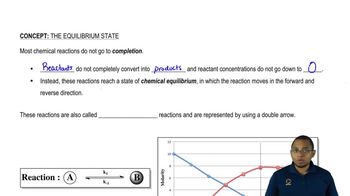
Chemical equilibrium occurs when the rates of the forward and reverse reactions are equal, resulting in constant concentrations of reactants and products. In the context of the given reaction, this means that ammonia (NH3) and oxygen (O2) are converting to nitrogen monoxide (NO) and water vapor (H2O) at a rate that balances with the reverse process, allowing the system to maintain a stable state.
Video consigliato:
Percorso guidato
03:42
Chemical Equilibrium Concept 1

Equilibrium Constant (K)

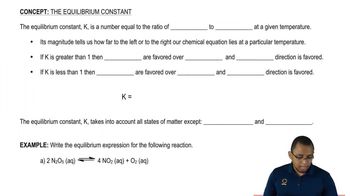
The equilibrium constant (K) is a numerical value that expresses the ratio of the concentrations of products to reactants at equilibrium, each raised to the power of their coefficients in the balanced equation. For the reaction provided, K can be calculated using the concentrations of NO and H2O divided by those of NH3 and O2, reflecting the extent to which the reaction favors products or reactants.
Video consigliato:
Percorso guidato
02:50
The Equilibrium Constant Concept 1

Le Chatelier's Principle

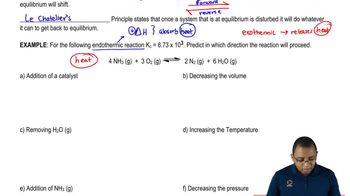
Le Chatelier's Principle states that if a dynamic equilibrium is disturbed by changing the conditions, the system will adjust to counteract the change and restore a new equilibrium. This principle is crucial for understanding how changes in concentration, temperature, or pressure can affect the position of the equilibrium in the reaction between ammonia and oxygen.
Video consigliato:
Percorso guidato
09:34
The following is an endothermic reaction where Kc = 6.73 x 10³.For each of the choices below predict in which direction the reaction will proceed
Pratica correlata
Domanda del libro di testo

Methanol, CH3OH, is used as race car fuel.

c. How many kilojoules are released by burning 50.0 g of methanol?

2364
views

Domanda del libro di testo

Sketch an energy diagram for a system in which the forward reaction has Eact = +25 kcal/mol (+105 kJ/mol) and the reverse reaction has Eact = +35 kcal/mol (+146 kJ/mol).

a. Is the forward process endergonic or exergonic?

2396
views
Domanda del libro di testo

Obtain a package of your favorite snack food and examine the nutritional information on the label. Confirm the caloric value listed by using the conversions listed in the table in the Chemistry in Action feature 'Energy from Food' (p. 191). Alternatively, you can use the estimates for caloric value for a given food as provided in the table.

b. How long would you have to engage in each of the physical activities to burn the calories contained in your snack?

2200
views
Domanda del libro di testo

Magnetite, an iron ore with formula Fe3O4, can be reduced by treatment with hydrogen to yield iron metal and water vapor.

d. This reaction has K = 2.3 × 10⁻¹⁸. Are the reactants or the products favored?

2785
views
Domanda del libro di testo

For the evaporation of water, H2O(l) → H2O(g), at 100°C, ∆H = +9.72 kcal/mol (+40.7 kJ/mol).

b. How many kilojoules are released when 10.0 g of H2O(g) is condensed?

3679
views
Domanda del libro di testo

Magnetite, an iron ore with formula Fe3O4, can be reduced by treatment with hydrogen to yield iron metal and water vapor.

a. Write the balanced equation.

3358
views