
Ch.7 Chemical Reactions: Energy, Rate and Equilibrium
McMurry - Fundamentals of General, Organic, and Biological Chemistry 8th Edition
McMurry8th EditionFundamentals of General, Organic, and Biological ChemistryISBN: 9780134015187Non è quello che usi tu?Cambia libro di testo
Capitolo 7, Problema 69d

Magnetite, an iron ore with formula Fe3O4, can be reduced by treatment with hydrogen to yield iron metal and water vapor.
d. This reaction has K = 2.3 × 10⁻¹⁸. Are the reactants or the products favored?

Guida verificata passo dopo passo
1
Step 1: Understand the equilibrium constant (K). The equilibrium constant (K) is a measure of the extent to which a reaction proceeds to form products at equilibrium. A very small K value (K << 1) indicates that the reactants are favored, while a very large K value (K >> 1) indicates that the products are favored.
Step 2: Analyze the given K value. In this problem, K = 2.3 × 10^(-18), which is an extremely small number. This suggests that the reaction does not proceed significantly toward the products and that the reactants are heavily favored at equilibrium.
Step 3: Relate the K value to the reaction. For the reaction Fe3O4 + H2 → Fe + H2O, the small K value implies that the concentration of the reactants (Fe3O4 and H2) will be much higher than the concentration of the products (Fe and H2O) at equilibrium.
Step 4: Conclude which side is favored. Since K is very small, the equilibrium lies far to the left, meaning the reactants are favored over the products.
Step 5: Summarize the reasoning. The extremely small equilibrium constant (K = 2.3 × 10^(-18)) indicates that the reaction does not proceed significantly toward the formation of products, and the reactants are strongly favored at equilibrium.

Risposta video verificata per un problema simile:

Questa soluzione video è stata consigliata dai nostri tutor come utile per risolvere questo problema.
Durata del video:
1m

Concetti chiave

Ecco i concetti essenziali che devi comprendere per rispondere correttamente alla domanda.

Equilibrium Constant (K)

The equilibrium constant (K) is a numerical value that expresses the ratio of the concentrations of products to reactants at equilibrium for a given reaction. A small K value, such as 2.3 x 10^-18, indicates that at equilibrium, the concentration of reactants is much greater than that of products, suggesting that the reaction favors the reactants.
Video consigliato:
Percorso guidato
02:50
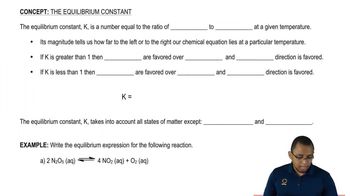
The Equilibrium Constant Concept 1

Reaction Favorability

Reaction favorability refers to the tendency of a chemical reaction to proceed in the forward direction (toward products) or reverse direction (toward reactants). In this case, a very low equilibrium constant suggests that the formation of products (iron metal and water vapor) is highly unfavorable compared to the reactants (magnetite and hydrogen).
Video consigliato:
Percorso guidato
1:30
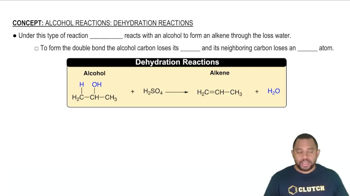
Alcohol Reactions: Dehydration Reactions Concept 1

Le Chatelier's Principle

Le Chatelier's Principle states that if a system at equilibrium is subjected to a change in concentration, temperature, or pressure, the system will adjust to counteract that change and restore a new equilibrium. Understanding this principle helps predict how changes in conditions might affect the favorability of the reaction between magnetite and hydrogen.
Video consigliato:
Percorso guidato
09:34
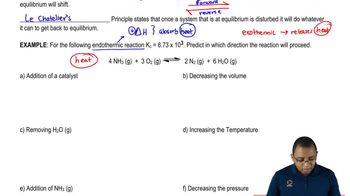
The following is an endothermic reaction where Kc = 6.73 x 10³.For each of the choices below predict in which direction the reaction will proceed