Ch.7 Chemical Reactions: Energy, Rate and Equilibrium
McMurry - Fundamentals of General, Organic, and Biological Chemistry 8th Edition
McMurry8th EditionFundamentals of General, Organic, and Biological ChemistryISBN: 9780134015187Non è quello che usi tu?Cambia libro di testo
Capitolo 7, Problema 37b

For the reaction
NaCl(s)→waterNa+(aq)+Cl–(aq),ΔH=+1 kcal/mol (+4.184 kJ/mol)NaCl\(\left\)(s\(\right\))\(\xrightarrow{water}\)Na^{+}\(\left\)(aq\(\right\))+Cl^{–}\(\left\)(aq\(\right\)),\(\Delta\) H=\(\text{+1 kcal/mol (+4.184 kJ/mol)}\)
b. Does entropy increase or decrease in this process?

Guida verificata passo dopo passo
1
Step 1: Understand the reaction. The reaction shows the dissolution of solid sodium chloride (NaCl) into its ions, sodium (Na⁺) and chloride (Cl⁻), in water. This process involves breaking the ionic lattice of NaCl and dispersing the ions into the solution.
Step 2: Recall the concept of entropy (S). Entropy is a measure of the disorder or randomness in a system. Processes that increase the number of particles or the distribution of energy typically result in an increase in entropy.
Step 3: Analyze the change in the system. In this reaction, a single solid (NaCl) is converted into two separate ions (Na⁺ and Cl⁻) in an aqueous solution. The ions are free to move in the solution, which increases the randomness and disorder of the system.
Step 4: Consider the physical states. Solids have a more ordered structure compared to ions in solution. The transition from a solid to dissolved ions represents a significant increase in disorder.
Step 5: Conclude the entropy change. Since the process involves breaking a solid lattice and dispersing ions into a more disordered state, the entropy of the system increases during this reaction.

Risposta video verificata per un problema simile:

Questa soluzione video è stata consigliata dai nostri tutor come utile per risolvere questo problema.
Durata del video:
2m

Concetti chiave

Ecco i concetti essenziali che devi comprendere per rispondere correttamente alla domanda.

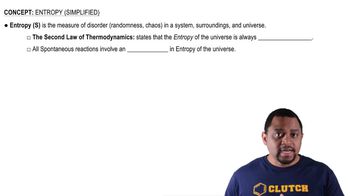
Entropy

Entropy is a measure of the disorder or randomness in a system. In thermodynamics, it quantifies the number of ways a system can be arranged, with higher entropy indicating greater disorder. When a solid dissolves in a solvent, such as NaCl in water, the ions become more dispersed, typically leading to an increase in entropy.
Video consigliato:
Percorso guidato
00:54
Entropy (Simplified) Concept 1

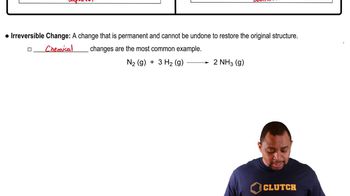
Enthalpy Change (∆H)

Enthalpy change (∆H) refers to the heat absorbed or released during a chemical reaction at constant pressure. A positive ∆H, as in the case of NaCl dissolving in water, indicates that the process is endothermic, meaning it requires energy input. This energy is used to break the ionic bonds in the solid and to separate the ions in the solution.
Video consigliato:
Percorso guidato
01:17
Physical & Chemical Changes

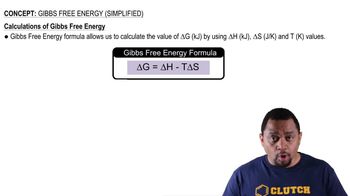
Gibbs Free Energy (∆G)

Gibbs Free Energy (∆G) combines enthalpy and entropy to determine the spontaneity of a process. The relationship is given by the equation ∆G = ∆H - T∆S, where T is the temperature in Kelvin and ∆S is the change in entropy. A process is spontaneous if ∆G is negative, which can occur even if ∆H is positive, provided that the increase in entropy (∆S) is significant enough.
Video consigliato:
Percorso guidato
01:04
Gibbs Free Energy (Simplified) Concept 3