Ch.7 Chemical Reactions: Energy, Rate and Equilibrium
McMurry - Fundamentals of General, Organic, and Biological Chemistry 8th Edition
McMurry8th EditionFundamentals of General, Organic, and Biological ChemistryISBN: 9780134015187Non è quello che usi tu?Cambia libro di testo
Capitolo 7, Problema 33

What two factors affect the spontaneity of a reaction?

Guida verificata passo dopo passo
1
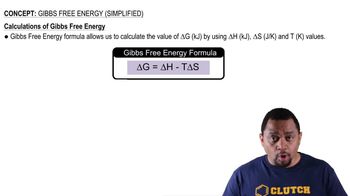
The spontaneity of a reaction is determined by the Gibbs free energy change (ΔG), which is calculated using the equation: ΔG = ΔH - TΔS, where ΔH is the enthalpy change, T is the temperature in Kelvin, and ΔS is the entropy change.
The first factor is the enthalpy change (ΔH). A reaction tends to be spontaneous if it releases energy (exothermic, ΔH < 0). If the reaction absorbs energy (endothermic, ΔH > 0), it may still be spontaneous depending on the other factors.
The second factor is the entropy change (ΔS). A reaction tends to be spontaneous if it increases the disorder of the system (ΔS > 0). A decrease in entropy (ΔS < 0) may still allow spontaneity if other conditions are favorable.
Temperature (T) plays a critical role in determining spontaneity because it affects the relative importance of the entropy term (TΔS) in the Gibbs free energy equation. At higher temperatures, the entropy term becomes more significant.
In summary, the two main factors affecting the spontaneity of a reaction are the enthalpy change (ΔH) and the entropy change (ΔS), with temperature (T) influencing their relative contributions to the Gibbs free energy (ΔG).

Risposta video verificata per un problema simile:

Questa soluzione video è stata consigliata dai nostri tutor come utile per risolvere questo problema.
Durata del video:
2m

Concetti chiave

Ecco i concetti essenziali che devi comprendere per rispondere correttamente alla domanda.

Gibbs Free Energy

Gibbs Free Energy (G) is a thermodynamic potential that helps predict the spontaneity of a reaction. A reaction is spontaneous if the change in Gibbs Free Energy (ΔG) is negative, indicating that the process can occur without external energy input. The relationship between enthalpy, entropy, and temperature is crucial in determining ΔG, making it a central concept in thermodynamics.
Video consigliato:
Percorso guidato
01:04
Gibbs Free Energy (Simplified) Concept 3

Enthalpy

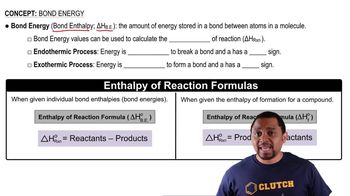
Enthalpy (H) is a measure of the total heat content of a system and is crucial in understanding the energy changes during a reaction. A reaction can be exothermic (releases heat, ΔH < 0) or endothermic (absorbs heat, ΔH > 0). The change in enthalpy affects the spontaneity of a reaction, as exothermic reactions tend to favor spontaneity under constant pressure.
Video consigliato:

Entropy

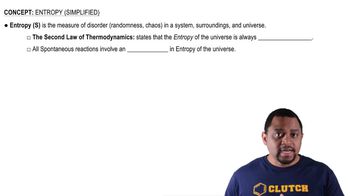
Entropy (S) is a measure of the disorder or randomness in a system. According to the second law of thermodynamics, the total entropy of an isolated system can never decrease over time. For a reaction to be spontaneous, the change in entropy (ΔS) must be positive, which often occurs when products are more disordered than reactants, contributing to the overall spontaneity when combined with enthalpy changes.
Video consigliato:
Percorso guidato
00:54
Entropy (Simplified) Concept 1