Ch.7 Chemical Reactions: Energy, Rate and Equilibrium
McMurry - Fundamentals of General, Organic, and Biological Chemistry 8th Edition
McMurry8th EditionFundamentals of General, Organic, and Biological ChemistryISBN: 9780134015187Non è quello che usi tu?Cambia libro di testo
Capitolo 7, Problema 45

What is a catalyst, and what effect does it have on the activation energy of a reaction?

Guida verificata passo dopo passo
1
A catalyst is a substance that increases the rate of a chemical reaction without being consumed in the reaction itself. It participates in the reaction but is regenerated at the end.
The role of a catalyst is to provide an alternative reaction pathway with a lower activation energy compared to the uncatalyzed reaction.
Activation energy is the minimum energy required for reactants to collide and form products. A lower activation energy means that more reactant molecules have sufficient energy to overcome this barrier, leading to a faster reaction rate.
The catalyst achieves this by stabilizing the transition state or forming intermediate species that require less energy to proceed to the products.
It is important to note that while a catalyst speeds up the reaction, it does not alter the equilibrium position or the overall energy change (ΔH) of the reaction.

Risposta video verificata per un problema simile:

Questa soluzione video è stata consigliata dai nostri tutor come utile per risolvere questo problema.
Durata del video:
1m

Concetti chiave

Ecco i concetti essenziali che devi comprendere per rispondere correttamente alla domanda.

Catalyst

A catalyst is a substance that increases the rate of a chemical reaction without being consumed in the process. It achieves this by providing an alternative reaction pathway with a lower activation energy, allowing the reaction to proceed more quickly. Catalysts are crucial in various industrial processes and biological systems, where they facilitate reactions that would otherwise occur too slowly.
Video consigliato:
Percorso guidato
1:17
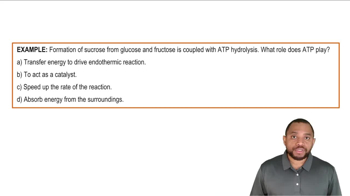
Coupled Reactions Example 3

Activation Energy

Activation energy is the minimum energy required for a chemical reaction to occur. It represents the energy barrier that reactants must overcome to transform into products. By lowering the activation energy, catalysts enable more reactant molecules to have sufficient energy to react, thereby increasing the reaction rate and efficiency.
Video consigliato:
Percorso guidato
1:06
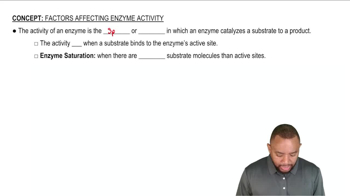
Factors Affecting Enzyme Activity Concept 1

Reaction Mechanism

A reaction mechanism is a detailed description of the step-by-step process by which reactants are converted into products in a chemical reaction. It outlines the individual steps, intermediates, and transition states involved. Understanding the reaction mechanism is essential for comprehending how catalysts influence the reaction pathway and the overall energy changes during the reaction.
Video consigliato:
Percorso guidato
1:30
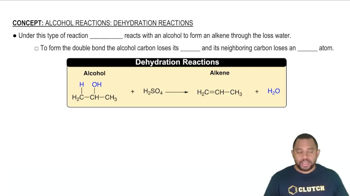
Alcohol Reactions: Dehydration Reactions Concept 1