Ch.7 Chemical Reactions: Energy, Rate and Equilibrium
McMurry - Fundamentals of General, Organic, and Biological Chemistry 8th Edition
McMurry8th EditionFundamentals of General, Organic, and Biological ChemistryISBN: 9780134015187Non è quello che usi tu?Cambia libro di testo
Capitolo 7, Problema 47a

For the reaction C(s, diamond) → C(s, graphite), ∆G = -0.693 kcal/mol (-2.90 kJ/mol) at 25 °C.
a. According to this information, do diamonds spontaneously turn into graphite?

Guida verificata passo dopo passo
1
Understand the role of a catalyst: A catalyst lowers the activation energy of both the forward and reverse reactions equally, without affecting the overall thermodynamic properties such as ∆G (Gibbs free energy).
Identify the activation energy change for the forward reaction: The activation energy decreases from 28.0 kcal/mol to 23.0 kcal/mol, which is a reduction of 5.0 kcal/mol.
Apply the principle of microscopic reversibility: Since the catalyst affects both the forward and reverse reactions equally, the activation energy for the reverse reaction will also decrease by the same amount, 5.0 kcal/mol.
Calculate the new activation energy for the reverse reaction: Subtract the same reduction (5.0 kcal/mol) from the original activation energy of the reverse reaction. To find the original activation energy of the reverse reaction, use the relationship between the forward and reverse activation energies and the ∆G of the reaction.
Use the relationship: Activation energy (reverse) = Activation energy (forward) + ∆G (in kcal/mol). Substitute the values to determine the original reverse activation energy, then subtract 5.0 kcal/mol to find the new activation energy for the reverse reaction.

Risposta video verificata per un problema simile:

Questa soluzione video è stata consigliata dai nostri tutor come utile per risolvere questo problema.
Durata del video:
1m

Concetti chiave

Ecco i concetti essenziali che devi comprendere per rispondere correttamente alla domanda.

Activation Energy

Activation energy is the minimum energy required for a chemical reaction to occur. It represents the energy barrier that reactants must overcome to transform into products. A catalyst lowers the activation energy, allowing the reaction to proceed more easily and quickly, but it does not change the overall energy difference between reactants and products.
Video consigliato:
Percorso guidato
1:06
Factors Affecting Enzyme Activity Concept 1

Gibbs Free Energy (∆G)

Gibbs Free Energy is a thermodynamic potential that measures the maximum reversible work obtainable from a thermodynamic system at constant temperature and pressure. A negative ∆G indicates that a reaction is spontaneous in the forward direction. The value of ∆G is related to the equilibrium position of the reaction and helps predict the favorability of both forward and reverse reactions.
Video consigliato:
Percorso guidato
01:04
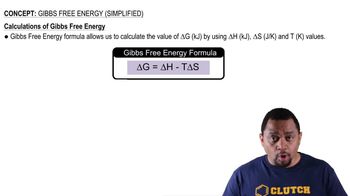
Gibbs Free Energy (Simplified) Concept 3

Catalysis and Reaction Direction

Catalysis refers to the process of increasing the rate of a reaction by adding a substance (catalyst) that is not consumed in the reaction. While a catalyst lowers the activation energy for both the forward and reverse reactions, it does not affect the Gibbs Free Energy change (∆G) of the reaction. Therefore, if the activation energy for the forward reaction decreases, the activation energy for the reverse reaction will also decrease by the same amount.
Video consigliato:
Percorso guidato
09:34
The following is an endothermic reaction where Kc = 6.73 x 10³.For each of the choices below predict in which direction the reaction will proceed