If a catalyst changes the activation energy of a forward reaction from 28.0 kcal/mol to 23.0 kcal/mol, what effect does it have on the reverse reaction?
Ch.7 Chemical Reactions: Energy, Rate and Equilibrium
McMurry8th EditionFundamentals of General, Organic, and Biological ChemistryISBN: 9780134015187Non è quello che usi tu?Cambia libro di testo
Tutti i libri di testo
McMurry 8th Edition
Ch.7 Chemical Reactions: Energy, Rate and Equilibrium
Problema 49
McMurry 8th Edition
Ch.7 Chemical Reactions: Energy, Rate and Equilibrium
Problema 49Capitolo 7, Problema 49
What is meant by the term 'chemical equilibrium'? Must amounts of reactants and products be equal at equilibrium?
Guida verificata passo dopo passo1
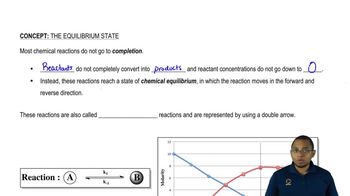
Chemical equilibrium refers to the state in a chemical reaction where the rate of the forward reaction (reactants converting to products) equals the rate of the reverse reaction (products converting back to reactants). At this point, the concentrations of reactants and products remain constant over time, though they are not necessarily equal.
Understand that equilibrium is a dynamic process, meaning that both the forward and reverse reactions are still occurring, but they happen at the same rate, so there is no net change in the concentrations of reactants and products.
No, the amounts of reactants and products do not have to be equal at equilibrium. The relative concentrations depend on the equilibrium constant (K), which is determined by the specific reaction and its conditions (e.g., temperature).
The equilibrium constant (K) is expressed as the ratio of the concentrations of products to reactants, each raised to the power of their respective coefficients in the balanced chemical equation. For example, for a reaction \( aA + bB \leftrightarrow cC + dD \), the equilibrium constant is \( K = \frac{[C]^c[D]^d}{[A]^a[B]^b} \).
In summary, chemical equilibrium is about the balance of reaction rates, not the equality of reactant and product amounts. The specific ratio of concentrations at equilibrium is determined by the equilibrium constant for the reaction.

Risposta video verificata per un problema simile:
Questa soluzione video è stata consigliata dai nostri tutor come utile per risolvere questo problema.
Durata del video:
1mConcetti chiave
Ecco i concetti essenziali che devi comprendere per rispondere correttamente alla domanda.
Chemical Equilibrium
Chemical equilibrium refers to a state in a reversible chemical reaction where the rates of the forward and reverse reactions are equal, resulting in constant concentrations of reactants and products over time. This dynamic balance means that while the reaction continues to occur, there is no net change in the amounts of substances involved.
Video consigliato:
Percorso guidato
Chemical Equilibrium Concept 1
Dynamic Nature of Equilibrium
Equilibrium is not a static condition; rather, it is dynamic, meaning that the reactants and products are constantly being converted into one another. This ongoing process allows for the concentrations of reactants and products to remain constant, even though individual molecules are still reacting.
Video consigliato:
Percorso guidato
Nature of Energy
Concentration Ratios
At equilibrium, the concentrations of reactants and products are related by the equilibrium constant (K), which reflects the ratio of product concentrations to reactant concentrations raised to the power of their coefficients in the balanced equation. This means that the amounts of reactants and products do not have to be equal; rather, they depend on the specific reaction and its conditions.
Video consigliato:
Percorso guidato
Percent Concentrations Concept 1
Pratica correlata
Domanda del libro di testo
2005
views
Domanda del libro di testo
For the reaction C(s, diamond) → C(s, graphite), ∆G = -0.693 kcal/mol (-2.90 kJ/mol) at 25 °C.
a. According to this information, do diamonds spontaneously turn into graphite?
1897
views
Domanda del libro di testo
Write the equilibrium constant expressions for the following reactions:
a. 2 CO(g) + O2(g) ⇌ 2 CO2(g)
1885
views
Domanda del libro di testo
Why do catalysts not alter the amounts of reactants and products present at equilibrium?
1910
views
Domanda del libro di testo
The reaction between hydrogen gas and carbon to produce the gas known as ethylene is:
2 H2(g) + 2 C(s) → H2C=CH2(g), ∆G = +16.3 kcal/mol (+68 kJ/mol) 25 °C.
a. Is this reaction spontaneous at 25 °C?
974
views
Domanda del libro di testo
Write the equilibrium constant expressions for the following reactions.
d. C(s) + H2O(g) ⇌ CO(g) + H2(g)
1881
views