Ch.9 Solutions
McMurry - Fundamentals of General, Organic, and Biological Chemistry 8th Edition
McMurry8th EditionFundamentals of General, Organic, and Biological ChemistryISBN: 9780134015187Non è quello che usi tu?Cambia libro di testo
Capitolo 9, Problema 67

What is an electrolyte?

Guida verificata passo dopo passo
1
An electrolyte is a substance that dissociates into ions when dissolved in water, allowing the solution to conduct electricity.
Electrolytes can be classified into strong and weak electrolytes based on their ability to dissociate completely or partially in solution.
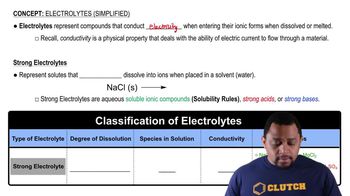
Strong electrolytes, such as sodium chloride (NaCl), dissociate completely into ions in solution, resulting in high conductivity.
Weak electrolytes, like acetic acid (CH₃COOH), only partially dissociate into ions, leading to lower conductivity compared to strong electrolytes.
Electrolytes are essential in various biological and chemical processes, including nerve function and maintaining fluid balance in the body.

Risposta video verificata per un problema simile:

Questa soluzione video è stata consigliata dai nostri tutor come utile per risolvere questo problema.
Durata del video:
2m

Concetti chiave

Ecco i concetti essenziali che devi comprendere per rispondere correttamente alla domanda.

Definition of Electrolytes

Electrolytes are substances that dissociate into ions when dissolved in water, allowing them to conduct electricity. Common examples include salts, acids, and bases. They play a crucial role in various biological processes, including nerve impulse transmission and muscle contraction.
Video consigliato:
Percorso guidato
02:48
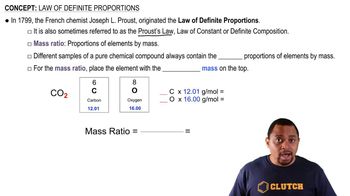
Law of Definite Proportions

Types of Electrolytes

Electrolytes can be categorized into strong and weak electrolytes. Strong electrolytes, like sodium chloride, completely dissociate into ions in solution, while weak electrolytes, such as acetic acid, only partially dissociate. This distinction affects their conductivity and reactivity in chemical processes.
Video consigliato:
Percorso guidato
02:38
Electrolytes (Simplified) Concept 1

Importance of Electrolytes in Physiology

In the human body, electrolytes such as sodium, potassium, and calcium are vital for maintaining fluid balance, regulating blood pressure, and ensuring proper muscle and nerve function. Imbalances in electrolyte levels can lead to serious health issues, highlighting their importance in physiological processes.
Video consigliato:
Percorso guidato
02:38
Electrolytes (Simplified) Concept 1