Ch.12 Introduction to Organic Chemistry: Alkanes
McMurry - Fundamentals of General, Organic, and Biological Chemistry 8th Edition
McMurry8th EditionFundamentals of General, Organic, and Biological ChemistryISBN: 9780134015187Non è quello che usi tu?Cambia libro di testo
Capitolo 12, Problema 31d

For each of the following, give an example of a member compound containing 5 carbons total:
(d) Ether

Guida verificata passo dopo passo
1
Step 1: Recall the definition of an ether. An ether is an organic compound characterized by an oxygen atom bonded to two alkyl or aryl groups (R-O-R').
Step 2: Understand the requirement of the problem. The compound must contain a total of 5 carbon atoms, distributed between the two alkyl groups attached to the oxygen atom.
Step 3: Choose two alkyl groups whose combined number of carbon atoms equals 5. For example, you could select a methyl group (CH₃-) and a butyl group (C₄H₉-).
Step 4: Write the structural formula of the ether by placing the oxygen atom between the two alkyl groups. For the example above, the ether would be CH₃-O-C₄H₉.
Step 5: Verify that the total number of carbon atoms in the compound is 5 and that the structure adheres to the general formula of an ether (R-O-R').

Risposta video verificata per un problema simile:

Questa soluzione video è stata consigliata dai nostri tutor come utile per risolvere questo problema.

Concetti chiave

Ecco i concetti essenziali che devi comprendere per rispondere correttamente alla domanda.

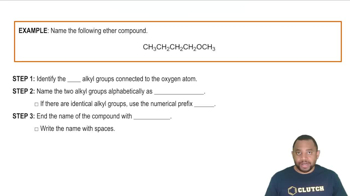
Ether

Ethers are a class of organic compounds characterized by an oxygen atom connected to two alkyl or aryl groups. They have the general formula R-O-R', where R and R' represent hydrocarbon chains. Ethers are known for their relatively low reactivity and are often used as solvents in organic chemistry. An example of a five-carbon ether is diethyl ether, which consists of two ethyl groups attached to an oxygen atom.
Video consigliato:
Percorso guidato
1:15
Naming Ethers Example 1

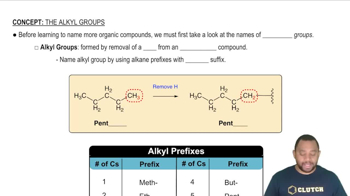
Alkyl Groups

Alkyl groups are derived from alkanes by removing one hydrogen atom, resulting in a functional group that can bond with other atoms. They are typically represented as 'R' in chemical formulas and can vary in size and structure. In the context of ethers, alkyl groups are the hydrocarbon portions that flank the oxygen atom. For example, in diethyl ether, the alkyl groups are two ethyl groups (C2H5).
Video consigliato:
Percorso guidato
2:26
Alkyl Groups Concept 1

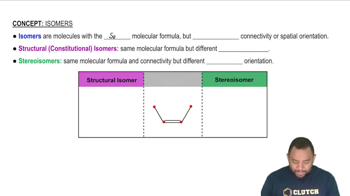
Structural Isomers

Structural isomers are compounds that have the same molecular formula but differ in the arrangement of atoms. This concept is important in organic chemistry as it highlights the diversity of compounds that can be formed from a given number of carbon atoms. For ethers with five carbons, different structural isomers can be created by varying the arrangement of the alkyl groups around the oxygen atom, leading to distinct compounds with unique properties.
Video consigliato:
Percorso guidato
2:16
Isomers Concept 1