Ch.12 Introduction to Organic Chemistry: Alkanes
McMurry - Fundamentals of General, Organic, and Biological Chemistry 8th Edition
McMurry8th EditionFundamentals of General, Organic, and Biological ChemistryISBN: 9780134015187Non è quello che usi tu?Cambia libro di testo
Capitolo 12, Problema 27

What characteristics of carbon make possible the existence of so many different organic compounds?

Guida verificata passo dopo passo
1
Carbon has four valence electrons, allowing it to form four covalent bonds with other atoms, which is essential for creating complex molecules.
Carbon atoms can bond with each other to form long chains, branched structures, and rings, providing a versatile backbone for organic compounds.
The ability of carbon to form stable single, double, and triple bonds with other carbon atoms and with other elements like hydrogen, oxygen, nitrogen, and halogens contributes to the diversity of organic compounds.
Carbon's small size allows it to form strong covalent bonds with other atoms, which is crucial for the stability of organic molecules.
The tetrahedral geometry of carbon's bonding allows for the formation of isomers, which are compounds with the same molecular formula but different structures, further increasing the diversity of organic compounds.

Risposta video verificata per un problema simile:

Questa soluzione video è stata consigliata dai nostri tutor come utile per risolvere questo problema.

Concetti chiave

Ecco i concetti essenziali che devi comprendere per rispondere correttamente alla domanda.

Tetravalency of Carbon

Carbon has four valence electrons, allowing it to form four covalent bonds with other atoms. This tetravalency enables carbon to create a diverse array of structures, including chains, branches, and rings, which are fundamental in forming various organic compounds.
Video consigliato:
Percorso guidato
5:36
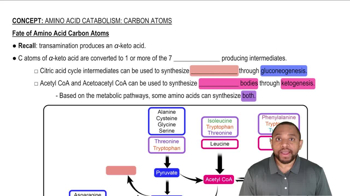
Amino Acid Catabolism: Carbon Atoms Concept 2

Catenation

Catenation is the ability of carbon atoms to bond with one another to form long chains or complex structures. This property is crucial for the formation of large organic molecules, such as proteins and nucleic acids, contributing to the vast diversity of organic compounds.

Functional Groups

Functional groups are specific groups of atoms within molecules that determine the chemical reactivity and properties of organic compounds. The presence of different functional groups allows for a wide variety of chemical behaviors and interactions, further enhancing the diversity of organic chemistry.
Video consigliato:
Percorso guidato
1:11
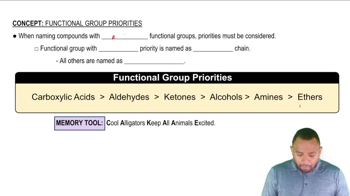
Functional Group Priorities Concept 1