Ch.12 Introduction to Organic Chemistry: Alkanes
McMurry - Fundamentals of General, Organic, and Biological Chemistry 8th Edition
McMurry8th EditionFundamentals of General, Organic, and Biological ChemistryISBN: 9780134015187Non è quello che usi tu?Cambia libro di testo
Capitolo 12, Problema 17

Write the structures of all singly chlorinated products that form when 2,4-dimethylpentane is reacted with Cl2.

Guida verificata passo dopo passo
1
Identify the structure of 2,4-dimethylpentane. It is a branched alkane with a five-carbon chain (pentane) and two methyl groups attached to carbons 2 and 4.
Understand that chlorination with Cl₂ in the presence of light (or heat) proceeds via a free radical substitution mechanism, where a hydrogen atom is replaced by a chlorine atom.
Determine all unique hydrogen atoms in the molecule. In 2,4-dimethylpentane, there are primary, secondary, and tertiary hydrogens. Each type of hydrogen can lead to a different chlorinated product.
Replace one hydrogen atom at a time with a chlorine atom, considering all unique positions. For example, replacing a hydrogen on the primary carbon (e.g., at carbon 1 or 5), secondary carbon (e.g., at carbon 2 or 4), or tertiary carbon (e.g., at carbon 3) will yield different products.
Draw the structures of all possible singly chlorinated products, ensuring that each product corresponds to a unique substitution site. Verify that no two products are identical (i.e., they are not structural isomers of the same compound).

Risposta video verificata per un problema simile:

Questa soluzione video è stata consigliata dai nostri tutor come utile per risolvere questo problema.

Concetti chiave

Ecco i concetti essenziali che devi comprendere per rispondere correttamente alla domanda.

Chlorination Reaction

Chlorination is a type of substitution reaction where chlorine (Cl₂) replaces hydrogen atoms in organic compounds. In the case of alkanes, this reaction typically occurs under UV light or heat, leading to the formation of chlorinated products. Understanding this process is crucial for predicting the products formed when 2,4-dimethylpentane reacts with chlorine.
Video consigliato:
Percorso guidato
0:47
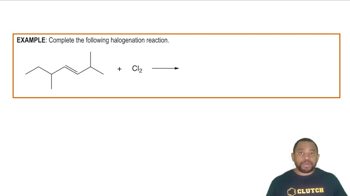
Halogenation Reactions Example 1

Stereochemistry

Stereochemistry refers to the spatial arrangement of atoms in molecules and how this affects their chemical properties. In the case of 2,4-dimethylpentane, the presence of multiple chiral centers can lead to different stereoisomers when chlorination occurs. Recognizing the stereochemical implications is essential for accurately identifying all possible chlorinated products.
Video consigliato:
Percorso guidato
1:30
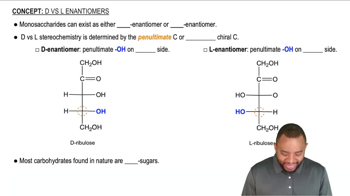
D vs L Enantiomers Concept 1

Product Distribution

Product distribution in a chemical reaction describes the relative amounts of different products formed. In chlorination reactions, the distribution can be influenced by factors such as the stability of the resulting radicals and steric hindrance. Analyzing the product distribution helps in understanding which chlorinated products are more likely to form when 2,4-dimethylpentane is reacted with Cl₂.
Video consigliato:
Percorso guidato
01:37
Solubility Product Constant (Ksp) Concept 2