Ch.12 Introduction to Organic Chemistry: Alkanes
McMurry - Fundamentals of General, Organic, and Biological Chemistry 8th Edition
McMurry8th EditionFundamentals of General, Organic, and Biological ChemistryISBN: 9780134015187Non è quello che usi tu?Cambia libro di testo
Capitolo 12, Problema 22a

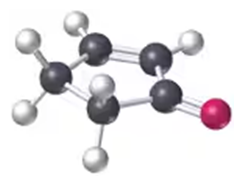
Convert the following models into line drawings (back = C; white = H; blue = N):
a.

Guida verificata passo dopo passo
1
Identify the elements in the molecular model: Carbon (C) is represented by black spheres, Hydrogen (H) by white spheres, and Nitrogen (N) by blue spheres.
Determine the connectivity of the atoms in the model by observing how the spheres are bonded to each other. Single bonds are represented by one connection, double bonds by two, and so on.
Translate the 3D structure into a 2D line drawing. Represent carbon atoms as vertices or endpoints of lines, and omit hydrogen atoms bonded to carbon for simplicity (assume implicit hydrogens).
Include all heteroatoms (e.g., Nitrogen) explicitly in the line drawing and show their bonds. For Nitrogen, write 'N' at its position and include any hydrogens bonded to it explicitly.
Double-check the line drawing to ensure it accurately represents the molecular structure, including the correct number of bonds and atom placements.

Risposta video verificata per un problema simile:

Questa soluzione video è stata consigliata dai nostri tutor come utile per risolvere questo problema.

Concetti chiave

Ecco i concetti essenziali che devi comprendere per rispondere correttamente alla domanda.

Line Drawings

Line drawings are simplified representations of objects or models using only lines to convey shape and structure. In the context of molecular models, line drawings typically depict atoms as points and bonds as lines, allowing for a clear visualization of molecular geometry and connectivity without the clutter of three-dimensional representations.
Video consigliato:
Percorso guidato
2:33
Drawing Enantiomers Concept 2

Color Coding in Chemistry

Color coding is a common practice in chemistry to represent different elements in molecular structures. For instance, carbon (C) is often represented in black, hydrogen (H) in white, and nitrogen (N) in blue. This system helps in quickly identifying the types of atoms present in a molecule and understanding its composition and structure.
Video consigliato:
Percorso guidato
03:25
The Genetic Code Concept 1

Molecular Models

Molecular models are physical or visual representations of molecules that illustrate their structure, composition, and spatial arrangement. These models can be ball-and-stick, space-filling, or line drawings, each providing different insights into molecular interactions and properties. Understanding how to convert these models into line drawings is essential for accurately depicting molecular relationships.
Video consigliato:
Percorso guidato
00:34
Molecular Models Example 1