Ch.13 Alkenes, Alkynes, and Aromatic Compounds
McMurry - Fundamentals of General, Organic, and Biological Chemistry 8th Edition
McMurry8th EditionFundamentals of General, Organic, and Biological ChemistryISBN: 9780134015187Non è quello che usi tu?Cambia libro di testo
Capitolo 13, Problema 61

2,2,3,3-Tetrabromopentane can be prepared by an addition reaction of excess Br2 with an alkyne. Draw the structure of the alkyne and name it.

Guida verificata passo dopo passo
1
Identify the product structure: The given compound, 2,2,3,3-Tetrabromopentane, has four bromine atoms attached to the second and third carbons of a pentane chain. This indicates that the starting alkyne must have a triple bond between the second and third carbons, as bromine adds across the triple bond in an addition reaction.
Determine the alkyne structure: To form 2,2,3,3-Tetrabromopentane, the alkyne must have five carbon atoms in total, with the triple bond located between the second and third carbons. The structure of the alkyne is CH3-C≡C-CH2-CH3.
Name the alkyne: The IUPAC name for the alkyne is 2-pentyne. The numbering starts from the end of the chain closest to the triple bond to give the lowest possible number to the triple bond.
Explain the reaction: When excess Br2 reacts with an alkyne, the bromine molecules add across the triple bond in two steps. First, the triple bond is converted to a double bond with two bromine atoms added. Then, the double bond reacts with more Br2 to form a single bond with four bromine atoms added in total.
Verify the product: After the addition of excess Br2 to 2-pentyne, the final product is 2,2,3,3-Tetrabromopentane, confirming that the starting alkyne is correctly identified as 2-pentyne.

Risposta video verificata per un problema simile:

Questa soluzione video è stata consigliata dai nostri tutor come utile per risolvere questo problema.

Concetti chiave

Ecco i concetti essenziali che devi comprendere per rispondere correttamente alla domanda.

Alkynes

Alkynes are hydrocarbons that contain at least one carbon-carbon triple bond. They are unsaturated compounds characterized by the general formula CnH2n-2. The presence of the triple bond gives alkynes unique reactivity, making them suitable for various addition reactions, such as halogenation with bromine.
Video consigliato:
Percorso guidato
4:11
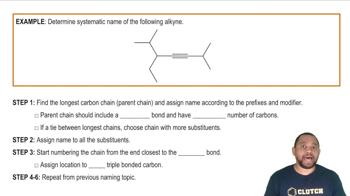
Naming Alkynes Example 1

Addition Reactions

Addition reactions involve the addition of atoms or groups to a molecule, typically across a double or triple bond. In the case of alkynes, the triple bond can react with halogens like Br2, resulting in the formation of a saturated compound. This type of reaction is crucial in organic synthesis for modifying molecular structures.
Video consigliato:
Percorso guidato
2:55
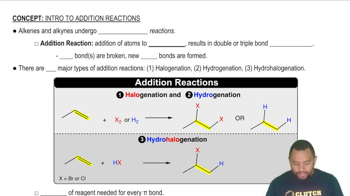
Addition Reactions Concept 1

Bromination

Bromination is a specific type of addition reaction where bromine (Br2) is added to a compound. For alkynes, this process can lead to the formation of dibrominated products, such as 2,2,3,3-tetrabromopentane. Understanding bromination is essential for predicting the products of reactions involving alkynes and for naming the resulting compounds.
Video consigliato:
Percorso guidato
0:35
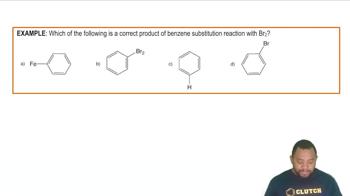
Halogenation Reactions Example 1