Ch.13 Alkenes, Alkynes, and Aromatic Compounds
McMurry - Fundamentals of General, Organic, and Biological Chemistry 8th Edition
McMurry8th EditionFundamentals of General, Organic, and Biological ChemistryISBN: 9780134015187Non è quello che usi tu?Cambia libro di testo
Capitolo 13, Problema 55

If bromocyclohexane were converted into cyclohexene, what kind of reaction would that be?

Guida verificata passo dopo passo
1
Identify the starting material and the product: Bromocyclohexane is the starting material, and cyclohexene is the product.
Recognize the functional groups involved: Bromocyclohexane contains a bromine atom attached to a cyclohexane ring, while cyclohexene is a cyclohexane ring with a double bond.
Determine the type of reaction: The conversion involves the removal of a bromine atom and the formation of a double bond, which is characteristic of an elimination reaction.
Consider the mechanism: This is likely an E2 elimination reaction, where a base abstracts a proton adjacent to the carbon bearing the bromine, leading to the formation of a double bond and the expulsion of the bromide ion.
Summarize the reaction type: The conversion of bromocyclohexane to cyclohexene is an elimination reaction, specifically an E2 mechanism.

Risposta video verificata per un problema simile:

Questa soluzione video è stata consigliata dai nostri tutor come utile per risolvere questo problema.

Concetti chiave

Ecco i concetti essenziali che devi comprendere per rispondere correttamente alla domanda.

Elimination Reaction

An elimination reaction is a type of chemical reaction where a molecule loses atoms or groups of atoms, resulting in the formation of a double bond or a ring structure. In the case of converting bromocyclohexane to cyclohexene, the reaction involves the removal of a bromine atom and a hydrogen atom, leading to the formation of a carbon-carbon double bond.
Video consigliato:
Percorso guidato
1:13
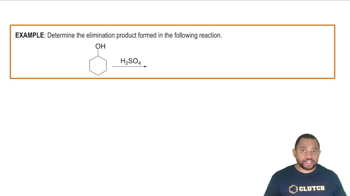
Alcohol Reactions Dehydration Reactions Example 1

Dehydrohalogenation

Dehydrohalogenation is a specific type of elimination reaction where a hydrogen halide (like HBr) is removed from a haloalkane. This process is crucial in the conversion of bromocyclohexane to cyclohexene, as it involves the elimination of bromine and a hydrogen atom, resulting in the formation of an alkene.
Video consigliato:
Percorso guidato
0:56
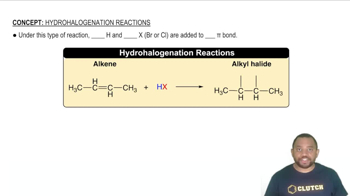
Hydrohalogenation Reaction Concept 1

Zaitsev's Rule

Zaitsev's Rule states that in elimination reactions, the more substituted alkene is typically the major product. This principle helps predict the outcome of the reaction when converting bromocyclohexane to cyclohexene, as the stability of the resulting alkene can influence the reaction pathway and product distribution.
Video consigliato:
Percorso guidato
1:24
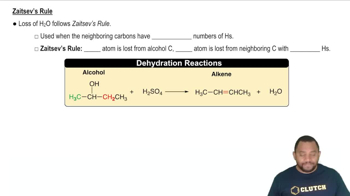
Zaitsev’s Rule Concept 2